After Qaddafi: Arabs
Must Change from Within or be Forced from Without
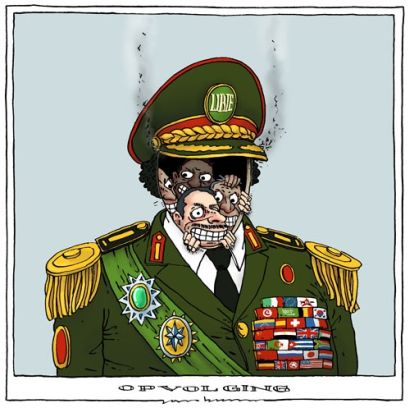
"Qaddafi
thought that because he was friends with Berlusconi and Sarkozy, he was safe. … Will Qaddafi have the dignity of a Saddam Hussein
when it comes to confronting his fate? … Libyan's may have hit reset, but what
will remain on the screen? Governments must incorporate the new data. It is not
yet midnight, but the clock is irreversibly ticking."
Qaddafi is finished. The die
was cast when the Security Council adopted a resolution approving a no-fly zone.
And yet, Colonel Qaddafi, terrified by the fate of
Saddam Hussein and his progeny, had already signed his
complete surrender to the West in 2003. He handed over everything and revealed all
of his secrets, putting Abdul Qadeer Khan, the father of Pakistan's
atomic bomb, in a very delicate position.
Qaddafi's realism was
remarkable. Such receptiveness greatly pleased the Bush Administration. The
White House saw in this change of course, engineered by Qaddafi's heir apparent,
Seif al-Islam, one of its rare diplomatic successes. Bush's
secretary of state, the frightening Condoleezza Rice, visited Tripoli in 2009 and praised The
Guide [Qaddafi]. She took the opportunity to hold Qaddafi up as an example to
the leaders of Iran and Syria, notably declaring that, "America has no
permanent enemies ... When countries are prepared to make strategic changes in
direction, the United States is prepared to respond."
Qaddafi excelled in the art
of survival, which allowed him, despite his mismanagement and incompetence, to endure
for four long decades. But like the two Arab leaders that fell before him - Ben Ali and Mubarak - Qaddafi despised his people and felt little need to
shield himself from their anger. Libyan society has been subjected to the whims
of an erratic leader who could publicly decree the abolition of the State and
at the same time multiply the security mechanisms for monitoring and controlling
society. Qaddafi decreed that political parties were a scourge. He thought that
because he was friends with Berlusconi and Sarkozy, he was safe. It never occurred to him that there
were Libyans who couldn't stand his traveling circus tent and endless
buffoonery. Will Qaddafi have the dignity of a Saddam when it comes to
confronting his fate?
But it was just like him to fall
victim to fickle Western friendships he thought he had definitively bought. His
"new" friends there seized the opportunity of the Libyan revolt to show
him the door. His one-time friends, the Russians and Chinese, decided not to save
the day. No one will miss the dictator, even if justifiably, some may think
that while Libya is free of Qaddafi, it won't be of its new "benefactors"
in the West. It continues to be comical to hear Berlusconi talk about Libyan
freedom! The Arabs have no monopoly on minstrels.
Libyan ruler Muammar Qaddhafi scolds Arab leaders over Palestine, Iraq and other issues, and warns them that after Saddam, any one of them may be the next to be hung by the Americans, at the Arab Summit in Damascus, Syria, Mar. 29, 2008.
But it must be noted that the
fall of the dictator, the third in the Arab region and second in our Maghreb, is heavy with meaning for those who see a new balance
of power taking shape. There is only one conclusion to be drawn: the moth-eaten
system of political-police guardianship has survived. And if it doesn't change
in an orderly fashion that safeguards the interests of the country and its
relative independence, it will be changed from without.
Such interference won't
necessarily take the form of military intervention. It may come in a more sophisticated
package. Regimes that don't understand how times have changed - and that their
authority is stronger with the free acquiescence and organized support of their
citizens - themselves become a threat to national security.
Posted
by WORLDMEETS.US
Oh yes, times have changed.
The USSR no longer exists, many nations have disappeared and others have been
amputated. And we have, within our southern border, a gigantic area to work
with. Let us ask the question: Libyan's may have hit reset, but what will
remain on the screen? Governments must incorporate the new data. It is not yet midnight,
but the clock is irreversibly ticking.



















![[Click Here for Jumbo Version]](http://www.groene.nl/uploads/0000/3785/Bertrams-22-08-11-libie.jpg?1314183433)