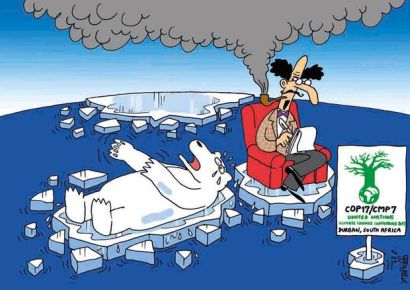
Dark Clouds for Kyoto
and Future Cuts in Emissions
"The worldwide release of
greenhouse gasses is growing at record rates, in spite of the efforts of
countries that signed the Kyoto Protocol. Neither the global financial crisis
nor the plunge into recession in leading economies has made any
difference."
Yesterday in Durban, South
Africa, week two of the U.N. conference on climate change and the Kyoto
Protocol began. Delegations from nearly 200 countries are in attendance. On the
agenda: the global environmental situation after 2012, when the Kyoto Protocol
is no longer in force. Ratified in 1997, Kyoto was history's first and only
international, legally-binding document for states that signed it. It was agreed
on by an absolute majority of nations. Among those who signed but failed to
ratify it is the United States. The goal of the Kyoto Protocol was to oblige
countries to reduce their greenhouse gas emissions. The year 1990 was chosen as
a baseline.
A study conducted by the Global Carbon Project
showed that since 1990, global emissions of harmful gases have not been reduced
relative to the 1990 baseline. Rather, they have actually increased by nearly
50 percent. And in the last decade, emissions rose by over 3 percent annually,
which is three times faster than during the 1990s. Even the global financial
crisis has failed to interrupt this trend. The biggest contributors to
environmental pollution are China, India, the U.S., Russia and the European
Union. And now the international community has to choose one of two paths to
follow after 2012: whether to extend the Kyoto Protocol or adopt an entirely
new international environmental agreement. There is, however, a third way:
postpone any concrete decision indefinitely, thus finding a politically correct
way of dispensing with the Kyoto restrictions. This is, apparently, the
preferred option for certain countries.
Earlier, international media
reported that Canada isn't excluding the possibility of withdrawing from the
Kyoto agreement. The Canadian government cites the fact that as long as
countries fail to comply with environmental regulations, signing international
agreements on reducing carbon emissions is meaningless. Now the most ardent
supporter of the Kyoto Protocol is the European Union. Europe has committed
itself to reducing its greenhouse emissions 80 percent by 2050. But further
emission reductions are becoming increasingly onerous for developed economies.
Against this background, developed countries are beginning to demand more firm
efforts by developing economies to reduce their own atmospheric emissions.
After all, China, for example, is already the world’s leading polluter,
followed by the U.S., India, and according to some sources, Russia. However,
China and other developing nations are trying to stall the adoption of any specific,
more stringent regulations with regard to themselves. According to sources
close to the talks, those avoiding a constructive dialogue include the Russian
side.
As reported by Nezavisimaya
Gazeta, environmentalists charge Russia with playing a less-than-transparent
political game. The Kremlin is playing for time and failing to take advantage
of the Kyoto Protocol's exclusions for environmental modernization. As was
noted by Igor Podgorny, chief of Greenpeace Russia’s energy efficiency program,
since Kyoto has been in effect, Russia shot the breeze and failed to commit to
making any ecological breakthroughs. The authorities talk about modernization,
innovation and energy efficiency, but Podgorny noted that the Kremlin has an
absolutely absurd forecast for completing projects related to energy efficiency
and renewable energy.
“Russian officials argue that
a number of projects have been registered in the course of implementing the
Kyoto Protocol. However, the complexity of project implementation in the Russian
Federation scares off potential investors,” says Sergey Voskresensky, a leading
expert with the engineering company “2K.”
So far, Russia has completed
only a few dozen projects involving environmentally-friendly production. As an
example, Podgorny cited the timber processing complex in northwest Russia. Many
of the larger plants were re-fitted to use their own waste to produce biogas
that ensures the supply of power. But Voskresensky notes that strictly within
the framework of the Kyoto Protocol, only one project related to
environmentally-friendly production has been completed. “Gazprom Neft laid a
pipeline direct from one of its oilfields to processing plants, which made it
possible to avoid gas flaring. In return, Gazprom Neft obtained technology and
equipment from Japanese companies Mitsubishi and Nippon Oil.”
The Kyoto Protocol requires
the use of mechanisms like emissions trading. Countries that have begun to
reduce their emissions are permitted to sell their quotas, i.e.: their right to
pollute, to other countries. Igor Podgorny admitted that overall, this
mechanism hasn't worked and has failed to yield any specific environmental or
economic results. But Vladimir Slivyak, co-chair of the environmental
organization EcoDefense, is confident that if the mechanism didn't work, it is
only due to the short-sightedness of bureaucrats. According to the ecologist,
the concrete financial benefit of emissions trading to Russia would be in the tens
of millions of dollars.
Slivyak recalled that today,
without putting any special effort into it, Russia has naturally reduced its emissions
compared to 1990 by 35 percent. At the same time, at the 2009 Climate Change
Conference in Copenhagen, President Dmitry Medvedev said that Russia had agreed
to reduce emissions by at least 10 percent before 2020.
“Based on official
statistics," Slivyak concludes," Russia does not want or plan to take
any real steps toward reducing emissions.”