"U.S.
has spent almost a trillion dollars in Iraq. But the money hardly
counts in light of such human suffering. … For better or worse, what has been
done cannot be undone. But we can at least try to learn from past mistakes. And
in the case of Iraq, it is above all about distinguishing what can and cannot
be achieved by military means."
Tariq Aziz, Saddam Hussein's chief aide, has given his first interview [read below] since the fall of Baghdad in which he explains the conduct of his government before both Gulf Wars, why Iraq pretended to have weapons of mass destruction, and expresses incredulity that the United States, in the person of Barack Obama, would ‘leave Iraq to the wolves’.
As the U.S.
prepares to withdraw, there are some promising signs in today’s Iraq. But the
rationale for the invasion was misleading, and the price was far too high.
On Monday, President
Barack Obama told a meeting of war veterans that he has fulfilled his promise
to end the war in Iraq.
The country that
the U.S. is now starting to pull out of is in much better shape than it was a
few years ago. Violence has dropped. In 2008, 4,645 civilians were killed - a
horrifying number, but the lowest since the 2003 invasion. The number of cars,
phones and Internet connections has risen sharply since 2003.
Iraqis feel safer
and more satisfied with their lives than ever before; 60 percent of the population
believes that their quality of life will improve. Oil production has risen and
more people have access to electricity and fuel, even if during July, Baghdad
only had five hours of electricity a day.
But Iraq wasn’t
invaded to improve the quality of life for civilians. It was the war and the U.N.
sanctions that preceded it that destroyed the infrastructure of Iraq, which was
a leading if brutally repressive state in the Middle East of the 1980s - with a
fairly high standard of living.
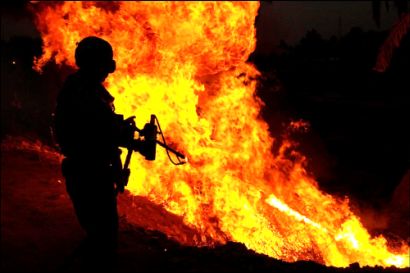
Metaphor
of Iraq: A U.S. soldier in Iraq uses a flamethrower to eliminate
brush
and make a highway safe from roadside bombs, Sept. 11, 2008.
Proponents of the
war offered four key reasons for attacking Iraq: the country had access to
weapons of mass destruction; the brutal regime of Saddam Hussein had to be
overthrown; Iraq was to be made a model democracy in the Middle East; and combating
international terrorism against the United States.
Of these
objectives, one has definitely been achieved. Saddam Hussein, one of the most
bloody and aggressive despots of the modern era, was deposed, arrested and brought
before a court. This was a major success that should not to be underestimated.
Iraq has also
moved toward democracy. The Kurdish region in northern Iraq is stable and
economically prosperous. And although the future remains uncertain, there is a
democratic structure in place in the rest of the country.
But apart from
this, the achievements are meager. Few neighboring countries are likely to view
Iraq as a role model. Saddam Hussein wasn't hiding any weapons of mass
destruction and there were no international terrorists in Iraq. On the other
hand, the war led to a wave of bloody terror in Iraq that is still going on.
At the other end
of the spectrum are the enormous costs. The U.S. has spent almost a trillion
dollars in Iraq. But the money hardly counts in light of such
human suffering.
There is no uniform
way of judging the numbers, but according to most estimates, around 100,000 Iraqis
have died in violent circumstances since the invasion. According to one
admittedly controversial analysis, if one counts disease, famine and other
causes, about 600,000 Iraqis died. The American losses are over 4,000 soldiers
dead and 30,000 wounded.
For better or
worse, what has been done cannot be undone. But we can at least try to learn
from past mistakes. And in the case of Iraq, it is above all about distinguishing
what can and cannot be achieved by military means.
Posted by WORLDMEETS.US
To remove Saddam
Hussein from power was a realistic goal, even if the price in human suffering
was extreme. But if this had been the only objective of the Bush regime, its
own public would never have supported it. With a mixture of false statements
about weapons of mass destruction, unfounded accusations of support for
al-Qaeda and unrealistic visions of a democratic breakthrough in the Middle
East, they managed to sell the war to the public.
When there are so
many overlapping reasons for a decision rather than a single good one, people
should be suspicious. This is an insight worth keeping in mind now, when operations
in Afghanistan are justified by a smorgasbord of reasons: the fight against
terrorism, building democracy, the liberation of women, regional security, etc.