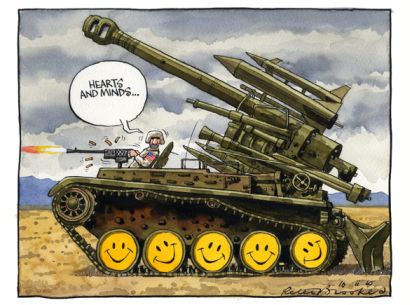
Germany Finally Acknowledges Civil War
in Afghanistan
"The
leading beneficiaries of this new assessment are the soldiers of the
Bundeswehr. Firstly, because they can now openly admit to often engaging in
battle … They will no longer face criticism if they speak of war."
It has come! Finally, yet
casually, Foreign Minister Guido Westerwelle
made an important admission. Afghanistan is in the grip of civil war - or, in
the words of Germany's highest ranking diplomat: a “non-international
armed conflict exists.” This position, previously held by Defense
Minister Karl-Theodor
zu Guttenberg, has serious consequences.
Posted
by WORLDMEETS.US
Politically, the Federal
Government has finally come to terms with reality and is drawing a provisional
line under the internal debate. Eastern and southern Afghanistan were never
really pacified after the violent overthrow of the Taliban regime by U.S.-led
forces at the end of 2001. And since 2004, attacks in other regions have steadily
risen. The north, where the Bundeswehr [German Army] is responsible, has seen
an increase in the official number of attacks on ISAF's
German contingent - from 21 in 2007 to 77 last year. In 2009, the Bundeswehr called
for U.S. air support 57 times.
Initially, it was the Red-Green
coalition [the SPD and the Greens]
and then the Grand Coalition [CDU
and CSU],
which had difficulty calling a spade a spade. Among other things, this was out
of fear of losing popular support. After all, the idea was to help rebuild the
country with a humanitarian mission. The tension between the public mission of
reconstruction and the actual mission of dealing with a civil war led to discussions
that were more about coming to terms with the past than with dealing with what
the objectives are for a mission in this far away land and how they can be
achieved.
The leading beneficiaries of
this new assessment are the soldiers of the Bundeswehr. Firstly, because they
can now openly admit to often engaging in battle; they no longer have to
explain why they haven’t drilled more wells or built additional schools. They
will no longer face criticism if they speak of war, as has happened in a number
of cases. Secondly, they no longer carry the "prosecutor in the backpack,”
as the troops refer to it. In taking action against the insurgents, they are
now bound by the international laws of war, which allows for far greater
freedom of action than the German Criminal Code. Where before they could only
use their weapons to defend themselves, now they can act militarily and are no
longer second-class ISAF soldiers. International law is not, however, carte
blanche to commit violence. The code stipulates that action proceed
exclusively against armed individuals - sparing civilians.
Posted
by WORLDMEETS.US
From this also follows that
the Bundeswehr will now have to adapt the way its train its forces. As far as
international law is concerned, these "citizens in uniform" still
have a lot to learn. Moreover, the so-called pocket card of the rules of
engagement can now be re-written.
Westerwelle’s strong words, however,
pose a problem. Strictly speaking, police officers can't be deployed in war
zones. Therefore, these officers can no longer be allowed to train Afghan
police - who are nevertheless essential to the rebuilding of the country and the
withdrawal options of allied forces. Westerwelle will no doubt need to clarify
this issue with Interior Minister Thomas de Maizière.