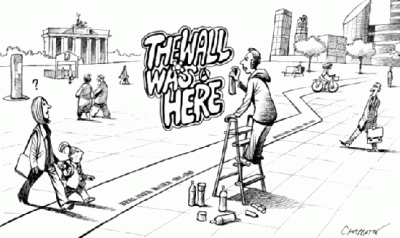
[Le Temps, Switzerland]
Rossijskaya Gazeta, Russia
World Hasn't Learned Lesson of the Berlin Wall
"With its destruction, the bipolar world that was
maintained by fear of mutual destruction ceased to exist. But the uni-polar
world has revealed its deficiencies."
EDITORIAL
Translated By Yekaterina Blinova
November 10, 2009
Russia - Rossijskaya Gazeta - Original Article (Russian)
Today, November 9, the
capitol of Germany celebrates a remarkable anniversary - twenty years since the
fall of the Berlin Wall, which was the symbol of the Cold War, a symbol of division
of the German capitol and state into two unequal parts, and most importantly, a
symbol of the implacable opposition of two political systems. And of course,
for Berliners, for the citizens of a united Germany and for all progressive
humanity, as was once said, the destruction of these symbols was a great and
happy holiday. The very holiday that whether intentionally or not, didn’t only
change life in Germany. It was as if a tiny atom caused a global chain
reaction.
Posted by WORLDMEETS.US
Following the destruction of
the Berlin Wall, the Warsaw
Pact collapsed, followed by the entire socialist system. The Soviet Union
ceased to be. Soviet troops located in East Germany, Poland, Czechoslovakia and
Hungary were rapidly withdrawn to their native land. Just counting Soviet
forces in Germany, 500,000 troops and military hardware including 115,000
armored personnel carriers, 4,000 tanks, 4,000 handguns and 2.5 million tons of
other material were removed. Real estate worth 10.5 billion deutsche marks [about
$19.5 billion] was left behind. Promises that “NATO
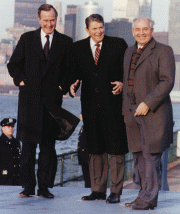
will not move a meter to the east” given to Soviet President Mikhail
Gorbachev by U.S. President George H. W. Bush turned out to be nothing more than words.
Countries once part of the
Warsaw Pact became members of NATO. Former Soviet republics were also inducted into
the organization - Lithuania, Latvia and Estonia. Ukraine and Georgia are named
candidates. But the question is - did this make peace more durable on this
planet? Alas, the answer, unfortunately, is ambiguous.
Literally a month after the
fall of the Berlin Wall, Bush Senior sent 26,000 of his soldiers to Panama,
thus showing that reliance on military force would remain decisive to U.S.
foreign policy. In the early 90s of the last century, the first Gulf War began
- and the second one in the beginning of this century. In between, Yugoslavia
was bombed and divided. Twenty percent of Serbian territory was chipped off to
create a NATO protectorate - a news state called Kosovo.
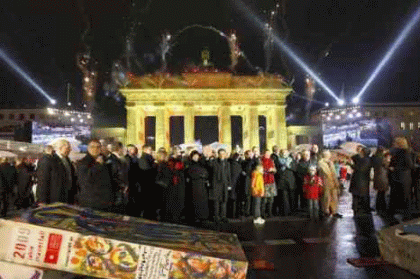
Celebrations
at the Brandenburg Gate for the 20th anniversary of
the
fall of the Berlin Wall, Nov. 9.
 CLICK HERE OR CLICK PHOTO FOR BERLINER
MORGANPOST SLIDE SHOW
CLICK HERE OR CLICK PHOTO FOR BERLINER
MORGANPOST SLIDE SHOW
SEE ALSO ON THIS:
Dernieres Nouvelles d'Alsace, France:
Wall's Lesson: Freedom Isn't All that Counts
Le Figaro, France:
Absent from Berlin, Obama Misses Grand Opportunity
Kayhan, Iran:
Triumphalism Over Fall of the Berlin Wall 'Just a Diversion'
Rossijskaya Gazeta, Russia
Gorby: West Must Come to Terms With Stronger Russia
Izvestia, Russia:
Truman and Churchill No Better Than Stalin

The Bush Jr. withdrew from
the 1972 Anti-Ballistic
Missile Treaty, which was considered the cornerstone of Russian and U.S.
security; Moscow froze its participation in the Treaty
on Conventional Armed Forces in Europe,
the terrorists struck the World Trade Towers in New York, which led to the ongoing
war in Afghanistan, and U.S. military spending rose to $670 billion … Then
there was war in South Ossetia [the Russia-Georgia War].
Of course, it’s no fault of
the Berlin Wall that global security and state security hasn't become more
reliable over the past 20 years. With its destruction, the bipolar world that
was maintained by fear of mutual destruction ceased to exist. But the uni-polar
world has revealed its deficiencies. It's obvious that states and their
alliances must alter their relationships by entering into a new system of
organization and security. A multi-polar system. Perhaps only beginning in Europe
- and then it must expand.
Posted by WORLDMEETS.US
But in order for that to
happen we must leverage the experience we gained 20 years ago when countries of
opposing camps moved toward one another, understanding that by agreeing with
their partners and abandoning a number of very insignificant differences, it would
benefit people. All peoples and all persons. This is the central lesson that
the Berlin Wall has taught us.
CLICK HERE FOR RUSSIAN VERSION
[Posted by WORLDMEETS.US November 17, 6:29pm]