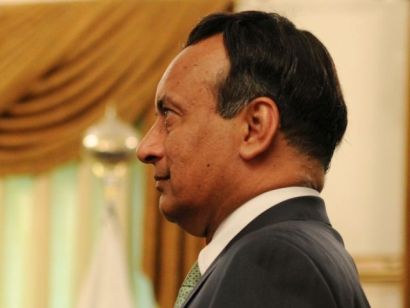
Former
Ambassador to the U.S., Husain Haqqani: Haqqani has
been accused of penning a memo seeking U.S. help to protect
civilian leaders from Pakistan's military. Revelations
about the
memo - known as 'Memogate' - have set off a firestorm.
The Frontier Post, Pakistan
Memogate Affair Suggests 'Diabolical American Plot'
"Missing from the debate are critical issues that should have drawn at least as much attention as the memo itself. Intriguingly, what was it that motivated Monsoor Ijaz to break the confidentiality of a top-secret memo? And why now, when relations between Pakistan and the U.S. are at such a low ebb? Is this part of some great game? Certain events do introduce a disconcerting vibe. Indeed, they smack of a systematic, sinister, carefully laid-out plot."
Patriotic Pakistani or forign spy?: Mansoor Ijaz, a prominent Pakistani American, has been caught up in 'Memogate' - after passing on a message he claimed was from civilian leaders asking for U.S. help preventing a coup.
After creating ripples in our
national pond with the stone of Memogate,
Pakistani-American Mansoor
Ijaz has let loose another bombshell. He now asserts that the chief of the
ISI, Lieutenant General Ahmed Shuja Pasha, secured
the consent of senior Arab leaders to sack the civilian government of President
Asif Zardari. In this way, Ijaz corroborated the central issue in his much
touted memo, that the Zardari regime was seeking to
prevent a military coup against it.
Given the credence that the memo
has achieved among our people, it will be hard to doubt Ijaz' new assertion. None
would be prepared to believe that he could be truthful in the first instance and untruthful
in the second. It would be irrational to think that people would take him at
his word about the actual memo, but not about the episode with Pasha. But this
should at least impel all and sundry to pause and question whether we as a
nation are being taken for a ride.
Missing from the debate are critical
issues that should have drawn at least as much attention as the memo itself. For
one - the timing of the memo's release is questionable. Intriguingly, what was
it that motivated Ijaz to break the confidentiality of a top-secret memo that
according to him, only a few were privy to? And why now, when relations between
Pakistan and the United States are at such a low ebb? Is
this part of some great game? Certain events do introduce a disconcerting vibe.
Indeed, they smack of a systematic, sinister, carefully laid-out plot.
By his own accounting, before
sending the memo to U.S. Joint Chiefs Chairman Mike Mullen, he had it
“reviewed” by a senior U.S. intelligence official - which
is why he says former CIA director and now defense secretary Leon Panetta had
come to know of it. But couldn’t it be the other way round? After all, CIA subversion
in foreign lands is an incontrovertible fact, documented meticulously in
numerous chronicles - not only by research scholars and historians but insiders,
including retired CIA spooks.
Going by his own assertion, Ijaz
obtained even the Pasha story from “top American spooks.” So what does all this
tell us, if not that there may be something deeper going on beneath these
methodical disclosures? Isn't it significant that all of this is emerging when
the unhappiness of America’s movers and shakers with the Pakistan establishment
is so public?
The Americans are plainly
miffed at Islamabad's latest moves to wrench back the sovereignty and
independence that Pakistan's rulers have surrendered to them over the years. Whether due to the infamous Raymond Davis case
or anger over the audacious May 2 commando raid on Abbottabad [killing bin
Laden], the Pakistani establishment had been moving perceptibly toward behaving
like a sovereign entity. This is certainly not to the liking of our American
overlords. They want to revert to the old order, with Islamabad at their beck
and call, the Pakistan military subordinated to the Pentagon and the ISI under
the CIA.
Since such things aren't
going Washington's way, they appear to be working on a complicated plan to
create schisms between political and military leaders in this country and to degrade
Pakistan's military in the eyes of its people. Although Pakistanis are
intensely outraged at the America's naked and fatal aggression [at the check
point] in Salala, their minds are deeply troubled
over grave concerns about the country’s security and its capacity to protect
its borders.
Therefore, partisans across
the political spectrum would do well not to be swayed by fixations and
antipathies and instead take a critical look at recent events. Pakistanis
should take care not to walk into some kind of trap laid to irreparably harm us.
We certainly are in the vortex of a sinister plot.
Posted
by WORLDMEETS.US
Just take a look at the
figures involved with Memogate. Mansoor
Ijaz's animus isn't just
against the Pakistani military and ISI, but the state of Pakistan itself. Even James Jones, the former U.S. national
security advisor and intermediary for transmitting the memo to Mullen, is known
for less than friendly feelings toward Pakistan and its establishment. All
through Jones' tenure at the National Security Council, he kept Pakistan on
tenterhooks, called India’s role in Afghanistan "excellent," and on
the same score, never missed a chance to berate Pakistan.
[Editor's Note: Earlier today,
General Jones submitted his affidavit to the Pakistan Supreme Court on Memogate, clearing Pakistan Ambassador Husain
Haqqani of having anything to do with the memo:
"Before May 9, 2011, I
received a phone call from Mr. Mansoor Ijaz. I have known Mr. Ijaz in a
personal capacity since 2006. During the call, Mr. Ijaz mentioned that he had a
message from the "highest authority" in the Pakistan government,
which he asked me to pass on to then Chairman of the Joint Chiefs of Staff
Admiral Michael Mullen ... At no time during the call do I remember Mr. Ijaz
mentioning Ambassador Haqqani. He gave me no reason to believe that he was
acting at the direction of Husain Haqqani, with his
participation, or that Mr. Haqqani had knowledge of the call or the contents of
the message.” Jones added that he informed Ijaz that he would not forward an
oral message of this kind to Admiral Mullen, and that if he wanted anything
forwarded, it would have to be in writing.]
Mullen himself had once
famously said that India has a military role to play in Afghanistan, and before
laying down his baton, he vilified the ISI for allegedly employing the Haqqani
network as its "veritable arm" in Afghanistan. Given all this, Pakistan's
political partisans must ensure that in their frenzy, they don't unwittingly play
into this diabolical plot.