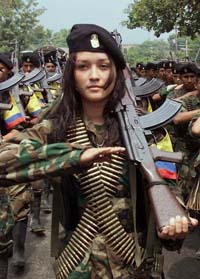
Revolutionary Armed Forces of Colombia
Guerillas: The
changing face of warfare.
Siglo Vientiuno, Guatemala
Iraq and Colombia: Wars Just
Aren't the Same Anymore …
"Like the temperature, the
seasons, the rain and other natural phenomena that in this new century no
longer respond to the old cycles we once knew, the dynamics of war (humanity's
most destructive activity) also seem to have changed."
Victor Galvez Borrel

Translated By Paula
van de Werken
January 14, 2008
Guatemala
- Siglo Vientiuno -
Original Article (Spanish)
Guatemala: Like
the temperature, the seasons, the rain and other natural phenomena that in this
new century no longer respond to the old cycles we once knew, the dynamics of
war (humanity's most destructive activity) also seem to have changed. Take two
hot spots for example.
The first is the
war in Iraq. Effectively, while the invasion of that country officially on May
1, 2003 (after the much-publicized victory if international coalition forces
led by the United States after 40 days of combat that devastated the Iraqi
Army). A few days later a different war began - and it continues today.
In the last four
and a half years (until the end of October 2007) that conflict has resulted in
4,145 dead soldiers (92 percent of them North Americans and a total of five
Salvadorans), as well as 28,171 wounded. In other words, 24
times more dead than during the initial invasion.
In addition to
recording more deaths after victory than during the initial invasion, this war
is characterized by the complexity of the battle being waged on several fronts:
against the troops of the international coalition, against the government and
the rebuilt Iraqi army (trained and subordinated to the invading forces), and
between the majority Shiite Muslims (55 percent of the population) and the
minority Sunnis (18 percent of the population).
This latter front
gives the conflict the feel of a civil war, which had up to now spared the
Kurds (21 percent of the population) but which now threatens to draw them in
due to the recent bombings of their territory [northern Iraq] by Turkey. This
feature creates the third and key paradox of this war: The troops of the
international coalition don't what to do in order to stay, but neither have
they found the formula to go. Attacks with “car bombs” and the taking of
hostages are two principal weapons of the fight.
The second “hot
spot” is the internal armed conflict in Columbia, the oldest in America, which
was ignored and isolated since it became impossible to conceal in 1980.
At first it
evinced the ideological outlines of the Cold War and the struggle for national
liberation. Insurrectionist groups (M-19, the ELN, FARC, etc.) opposed the Army
and counter-insurgents (the self-defense forces and paramilitaries). Over the years, ideological and political identities
became blurred as the war became bogged down and polluted by two very lucrative
illicit activities: smuggling contraband weapons and trafficking drugs (which
have also infiltrated the forces of the State).
Many now argue
that the remaining rebel groups remain due to such activities alone, since the
earlier ideologies or political relationships no longer exist. Apart from the
control and influence over territory and people (which is understandable given
the needs of drug production), the taking of hostages is also a main feature of
this war, the only one on the continent.
But if in Iraq,
hostage-taking is used as a bargaining chip to push for the withdrawal of
foreign troops or to finance the war, in Columbia - judging from the very few
cases that have been resolved and the very long periods of captivity - this
doesn’t appear to be the case. Hostages in Colombia suffer an average of six to
eight years of captivity, and 3,500 to 4,000 are now being held by bands of
guerillas.
It's difficult to
understand the dynamics of this war which, like all others, feeds on the
civilian population, but which in this case the capture of civilians doesn’t
seem to serve the same function as usual - they aren't exchanged immediately
and without intermediaries, but are retained in order to demonstrate presence,
territorial control and power.
Click Here for
Spanish Version