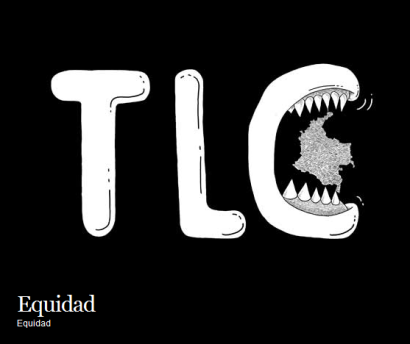
Will Trade with 'U.S. Imperialists' Damage Colombian Interests?
"So what do we think about Washington's concerted
effort to force Colombia to pay everyone a fair wage? We think it would sink
the country. And the entire population will have to emigrate en masse to find decent employment in
the United States. … U.S. imperialism has not been distinguished by its
inclination to protect the lives of others, but its tendency to exterminate
them."
Suddenly,
two columnists from El Tiempo, María Isabel Rueda and Mauricio Vargas, seem
concerned about Colombia's sovereignty. They say they sense "a whiff of
imperialism" in the new labor conditions that the U.S. government required
of Colombia in exchange for approving, or announcing that it will seek Congressional
passage for, the Colombian Free Trade
Agreement [FTA]. This is a deal that Colombia has pleaded for,
without success, for many years. Truth be told, these are quite basic demands: protect
the lives of trade unionists, guarantee the payment of benefits directly to
workers and prohibit the "scheme" - the "fiction" - (these
are the words of another El Tiempo columnist - Abdón Espinosa) perpetrated
by criminal cooperatives designed to circumvent their legal obligations. And
it's curious. Neither María Isabel nor Mauricio caught the same "whiff"
in any of the other parts of the FTA, signed while groveling "rather
quickly" (former President Álvaro Uribe's own words) five years ago by the
Colombian side, its government, and its Congress, and negotiated (just an expression)
by the current head of planning for President Juan
Manuel Santos' government. It's only when by chance it is of benefit to someone
in Colombia - in this instance, workers and their union representatives - that
they notice this odor, and become concerned.
During
an interview with Colombian Ambassador to Washington Gabriel Silva, María Isabel Rueda insisted on dwelling on this imperial
"imposition." Silva assured her that, on the contrary, "the term
imposition seems incorrect" because "this is a reflection of President
Santos' own philosophy on labor matters," and "when you're following what
own convictions dictate, it cannot be called an imposition."
Posted by WORLDMEETS.US
Ah,
yes. It's like that phrase of former President Ernesto Samper. When he was in
charge and performed his usual objectionable act and didn't want U.S. Ambassador
Frechette to deprive him of a U.S. visa, he would say: "It isn't
by coercion, but by conviction." If one is to believe Ambassador Silva, Colombia's
new commitments are a favor being done for the United States: "We're
giving President Obama political space to align with Colombia, because the FTA's
time has come."
On
the other hand, Semana columnist León Valencia exults: "The Colombian
trade union movement obliged President Obama to force the country to protect
and extend labor rights and combat aggression against trade unionists." And
he recalls the fact that of all work-related deaths across the world in the
last 20 years, some 63 percent were Colombian. But that was then. Abdón
Espinosa agrees that this was "in the past" and that it created an
"atmosphere which is frowned upon abroad."
I
believe all three are mistaken, Espinosa, Silva and Valencia - that they have
been lulled by wishful thinking. Since when have they stopped murdering
unionists here? Since when is it the Colombian ambassador to Washington who controls
the president's U.S. agenda? When have workers from another country successfully
imposed either their will or their rights on the White House? Instead, I agree
with Vargas and Rueda: This is a crude and brazen imperialist imposition by the
United States. And may everything possible be done to prevent murders and not,
as has been the norm, facilitate them.
Although,
taking suspicion to its logical extreme, it's not too much to note that the new
and principally humanitarian obligations that the FTA imposes on Columbia largely
deprive it of most of its only advantage in this unequal agreement: the low
cost of her labor force. Those costs are going to rise if benefits are to be
paid and intimidation by threat of death for those seeking better wages is to
be abandoned.
So
what do we think about Washington's concerted effort to force Colombia to pay everyone
a fair wage? We think it would sink the country. And the entire population will
have to emigrate en masse to find
decent employment in the United States.
Yet the
same suspicion is what makes me doubt this will happen. I note that in his
account, León Valencia says that the most commonly murdered unionists are -
apart from teachers, inherently endangered because they teach - those who work
in banana farming and the oil sector. And I don't think it's a coincidence that
these are the sectors that include the largest number of U.S. companies in Colombia.
As I said a few lines ago, U.S. imperialism has not been distinguished by its
inclination to protect the lives of others, but its tendency to exterminate
them.
It
astonishes me that the columnists from El Tiempo have yet to realize that.