Obama's Reelection
Hinges on Proving Government Can Work
"The
president may have embarked on his reelection campaign a little earlier than Bush
or Clinton. But for now, his greatest concern is whether he will have the money
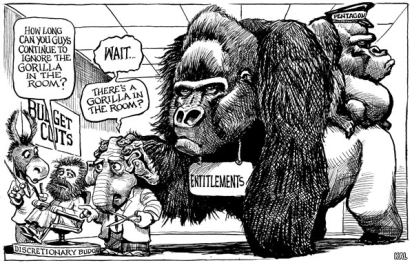
to make the government work. If it's up to Republicans, the size of the
government, now about 23 percent of the U.S. economy, will drop to 15 percent
by 2050. This is no part of Obama's plans."
Nineteen months from the U.S.
elections and the campaign is already on fire. President Obama launched his re-election
his way: high-tech, by email and video. His aim is to reenergize the supporters,
staffers, volunteers and donors who made the difference in 2008, and with an
eye on independent voters and amassing a record campaign war chest. Three years
ago, the Obama armies raised $750 million and some people think they can raise $1
billion by the end of the 2012 campaign.
Yesterday, the federal
government was threatening to shut down (not for good - just a halt) amid
fierce negotiations with Republicans in Congress over the budget. Obama the candidate
was bombarded by an opposition prepared to lead the government to collapse due
to a lack of funds, unless he agreed to further heavy cuts. It's clear that
Republicans, even with no viable declared candidates, have a major electoral weapon
with the budget.
This is reminiscent of a
similar situation experienced by another Democratic president, Bill Clinton, who
also had to reduce government operations to a minimum in order to break a budget
impasse with the opposition. Both then as now, Republicans had been
reinvigorated by victories in the mid-term elections.
Clinton changed course, bounced
back and was re-elected. In his favor, Clinton had the longest period of
economic growth in U.S. history, and he managed to end the greatest war that
the U.S., through NATO, had yet been involved in - in the former Yugoslavia. Obama,
by contrast, faced the Great Depression, the largest crisis of capitalism since
the crash of 1929 and the depression that followed in the 1930s. Furthermore, he
had to deal with two wars in Iraq and Afghanistan inherited from Bush’s
government. Obama managed to get the U.S. out of the first, still faces a very
complicated situation with the second, and is striving to rid the country of a
third, in Libya, while continuing to support his allies against the dictator Qaddafi.
Obama's chances very much depend
on the recovery of the American economy. The key is the unemployment rate, which
remains stubbornly high despite the general improvement of the business
environment. But last month, the U.S. created 216,000 jobs, which reduced the unemployment
rate from 8.9 percent to 8.8 percent - not a lot, but indicating a positive trend.
Another gamble by Obama, still
completely undecided, is his foreign policy. His smart-power style, as opposed
to Bush’s barbarism, is now undergoing its greatest test with the revolutions
in the Arab world. Tunisia and Egypt went well, but the big challenge of the
moment is Libya. The worst would be a partition or extension of the Western
presence in the country, which could inflame radical Islamic forces. In addition,
there are difficult situations in Yemen and Bahrain.
Posted by WORLDMEETS.US
The president may have
embarked on his reelection campaign a little earlier than Bush or Clinton. But
for now, his greatest concern is whether he will have the money to make the
government work. If it's up to Republicans, the size of the government, now about
23 percent of the U.S. economy, will drop to 20 percent by 2015 and 15 percent
by 2050. This is no part of Obama's plans.