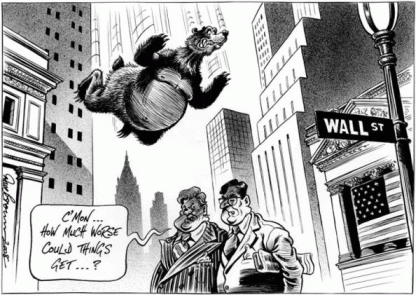
[The Independent, U.K.]
O Globo, Brazil
Bush's
Optimistic Speech Can't
Hide His
Economic 'Impotence'
"If the economic
consequences, as mentioned above, are difficult to foresee, the political
consequences seem reasonably clear - especially for American politics ...
Change benefits the Democrats - and runs counter to the general perception of a
government that (once again) is trying to use words to cover up reality."
By William Waack

Translated By Brandi Miller
March 17, 2008
Brazil - O
Globo - Original Article (Portuguese)
|

|
|
President Bush delivers words of
economic optimism on St. Patrick's Day.
|
|
|
In Washington this Monday
(3/17), St. Patrick’s Day should have been a day of celebration. It has become
popular in the United States to enjoy (in general, with a lot of beer) this day
of Ireland’s patron saint. But George W. Bush cancelled the party to talk about
an issue that he claims isn’t that serious: the global financial crisis.
It's obvious to
any market novice that Bush (or any other head of state of a major economy)
couldn't have said anything other than what was heard today. Instead of crisis,
the American President prefers the word “challenge.” Are the Americans in
recession? “The world will envy us again soon,” he responded.
Even less can one expect the
American president or any of his principle subordinates to say that the
government in Washington is ready to save other banks in difficulty (as was
done with Bear Stearns) - or if there is another package being prepared to ease
the lives of those who cannot comply with the rules of the mortgage system
(Bush recently approved a $170 billion Congressional package).
Then why convene meetings?
And why make announcements? Critics cited mainly in the European press say that
Bush’s attempt on Monday to verbally counteract a financial tsunami (of a still
unknown amplitude, depth and consequence) recalled the crisis of 1929, which
made then- Republican President Herbert Hoover a folkloric character - for
having ignored the signs of a catastrophe. “The president's hands-off attitude
is reminiscent of Herbert Hoover in 1929, in 1930,” shot Democratic senator
Charles Schumer to the International Herald Tribune today  .
.
There really isn't much the
American government can do at the moment, a fact which is universally
recognized. The Republican candidate for president, John McCain, released a
statement praising the attempt by the American central bank, the Federal
Reserve, to stimulate the financial system (even if that means saving Bear
Stearns - a bank that created its own difficulties) – and he never even
mentioned Bush. Government impotence leads to market tranquility. What they fear
is an admission that the FED may have run out of tools.
Posted by WORLDMEETS.US
Ben Bernanke, the chairman of
that institution, is respected in the academic world as one of the great
scholars of the depression of the 1930s, which resulted from the October 1929
crash. But the main argument of skeptics regarding the ability of the FED to
ease the crisis is substantial: to combat a lack of liquidity, not even the
FED's reserve of cash ($800 billion) will do the job - and in regard to
combating a crisis of insolvency (that is, the default of those with
mortgages), it would be even less effective.
A few weeks ago, celebrated
columnist Paul Krugman summarized the most worrisome element of the crisis: a
loss of trust in the basic functioning of the economic system. Confronted by
this, Bush in fact seems quite insignificant. The same solution that was tried
for the 2001 recession (a monetary loosing) has already been tried - and the
crisis seems to be deepening rapidly.
Posted by WORLDMEETS.US
If the economic consequences,
as mentioned above, are difficult to foresee, the political consequences seem
reasonably clear - especially for American politics, which confronts an
important decision this November. The idea that the American government is incompetent
or incapable is spreading to a political situation in which the word “change”
is the most uttered.
Change benefits the Democrats
- and runs counter to the general perception of a government that (once again)
is trying to use words to cover up reality. Even though Bush, as he is doing
now, can do nothing except talk with optimism.
CLICK
HERE FOR PORTUGUESE VERSION
[Posted by WORLDMEETS.US March 19,
12:12am]