U.S. Scheme to Shut Down the Web Rivals the Censorship of Beijing
"Paradoxically,
this brings the U.S. closer to China, which just months ago was loudly
denounced by Hillary Clinton for Internet censorship. It is indeed a contradiction
that in an era of growing de-Westernization, a further step in this dangerous
direction is being taken by the United States of all places, the creator and
greatest beneficiary of Western political ideas."
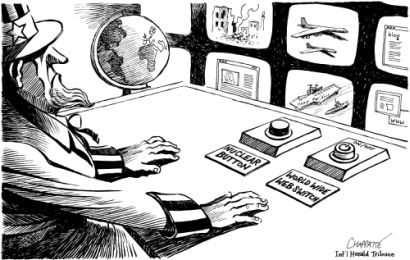
The Oval Office: A new propasal to give the U.S. president the power to shut down the planet's electronic nervous system has people in other nations worried.
In case of a cyber attack
that could undermine (economic) national security, the President of the United States
may shut down the Internet for a period of 90 days without prior
authorization by Congress. [From the Protecting
Cyberspace as a National Asset Act proposed by Senator Joe Lieberman]
This is the wording approved by
the Senate Committee on Governmental Affairs that will likely pass on
the Senate floor. It's an act with great symbolic value.
Not even after the September 11
terrorist attacks did we anticipate that the Executive could "confiscate"
the Web from its citizens for such a long period by simple presidential order.
The 90-day period directly evokes another particularly delicate case in which
the exercise of presidential power is afforded wide discretion. It is the
arrangement under which the president can deploy American forces for 90 days
without formal authorization from Congress. Since World War II, U.S. involvement
in most conflicts have been undertaken under this discretionary power. Now that
the Internet is likely to be the battleground of the future - and in many ways
could be a more dangerous field of battle than the traditional ones - the U.S. is
playing catch up to put its national defense in a position to act in a timely fashion.
That the cyber threat is far
from a hypothesis of science fiction fantasy is testified to by a number of
recent experiences and the evolution of NATO's core strategic doctrine. Over recent
years, Lithuania, an E.U. member and member of the Atlantic Alliance, was
subjected to an actual cyber assault by Russia. The Chinese secret services, in
their turn, have been accused by the British government (among others) as
having repeatedly attempted to breach defense sites and industrial firms linked
to national security. The same strategic doctrine of the Alliance, which is now
under review, provides for more attention to be devoted to countermeasures in
case of cyber attacks against NATO and its members.
On the other hand, however,
it is easy to see that due to the very nature of the worldwide Web, a closure
of U.S. providers would have consequences far beyond the borders of the United
States. Yet, once again, just as has occurred with bipartisan regularity since
the end of the Cold War (with the exception of the first Bush Administration), the
multilateral implications of unilateral solutions are given very little
consideration along the banks of the Potomac. Such was the case with George W.
Bush and his neo-con advisers, and the pattern seems like it is being
reproduced with Barack Obama and his liberal eggheads.
But this isn't the only cause for concern. It's clear that the impact of such measures
on the civil liberties of the United States would be much greater that the similar
provision allowing for the deployment of combat troops abroad. On the one hand,
it remains to be seen how public opinion and libertarian groups will react.
What would they have said if the same provision had been enacted under the Bush
Administration? Second, one should frankly acknowledge that the gulf between
the U.S. and Europe has deepened with respect to maintaining an optimal balance
between the protection of individual liberty and civil rights on the one
hand, and collective security on the other. Paradoxically, this brings the U.S.
closer to China, which just months ago, was loudly denounced by U.S. Secretary
of State Hillary Clinton for Internet censorship. It is indeed a contradiction
that in an era of growing de-Westernization, a further step in this dangerous
direction is being taken by the United States of all places, the creator and
greatest beneficiary of Western political ideas.
*Vittorio
Emanuele Parsi of a Professor of political science at the Catholic University
of the Sacred Heart in Milan