Secretary
of State Clinton signs the book of condolence for Polish
President
Kaczynski and his entourage, with Polish Ambassador
to the U.S.,
Robert Kupiecki, at Poland's Washington Embassy.
Gazeta Wyborcza, Poland
A Catastrophe for Poland; Sadness in Washington
"It
has been many years since I've heard people in the U.S. speak with such
sympathy about Poland. Then came the exquisite words of Barack Obama. … I think
that all of those who died are watching this from above. And they're happy that
this is the way the world is talking of Poland."
A woman holds a picture of late Polish President Lech Kaczynski during a march in Krakow for the victims of Saturday's air crash near Smolensk. All 97 people aboard were killed.
WASHINGTON: The telephone
calls and e-mails kept coming on Saturday. And the people who called weren't
just American diplomats, former ambassadors to Warsaw, or Poland and Europe specialists
from Washington think tanks. There were also ordinary Americans, acquaintances,
neighbors, and sometimes they were people we hadn’t been in touch for
years. No one was able to say very much. But they all offered us their
solidarity and prayers. And they helped Kasia, I, and the children, who
don't understand everything but also cry, bear the sense of emptiness,
depression and senselessness.
We all went to the Polish
Embassy in Washington. The adults were dressed in somber black, while the children
decided to wear color because, as our 5-year-old Zosia said, “I want Poland to
be colorful again one day.” In the early afternoon on Saturday, there weren't yet
too many flowers in front of the Embassy - perhaps 20-30 bouquets, and a few
candles. The children and a few Polish friends lit several more and arranged them
in the shape of a cross. An American couple added a rose; we entered in order to
sign the condolence book. There were mostly Poles in line: elderly and very
young, studying in the U.S. capital or Polish-American couples. But there were
also Americans. A young, dapper Black man chose his words carefully and wrote
for about 10 minutes; his entry was half a page long. The Poles were quicker: “A
terrible tragedy,” “God bless their memory,” “Why does our country have to endure
such disaster???”
Posted
by WORLDMEETS.US
As we leave, there are more
flowers in front of the building, but not too many. A fashionably-dressed youth
is walking down the street. He doesn't notice the candle lights, trampling over
them, knocking over a few and breaking two. When we try to reprimand him, he
doesn’t even hear; he's plugged into his iPod.
Our mood deteriorates. “I
wonder whether on Monday, any of the Yankees at work will even think of
offering a word of condolence,” sighed our friend Ewa, who works at a large
American company. But after a moment, someone from our group receives another
phone call from a sympathetic American.
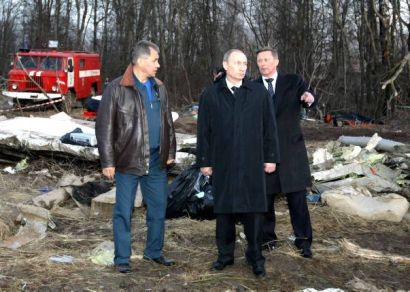
Russian
President Putin takes in the horrific scene near Smolensk,
Russia, at the site of a crash that took the
lives
of 97 of Poland's
leading lights, April 11.
As we park in front of our home,
a neighbor, known for his lack of subtlety, yells from a distance: “What the
hell has happened in that country of yours?” We could have killed him … But in
front of our door there were flowers from other neighbors - friends from down
the street. And then there were more nice, comforting phone calls.
Then I went to Baltimore,
where the Polish Diaspora is much larger than in Washington. When I arrive at
the site of the imposing Katyn
Massacre Memorial, the wake has just ended. There are still dozens of
people and lots of flowers. Some Americans came up to us and one of them named Jeff
saw a ribbon with the colors of Poland with black on my lapel and said, “We
know what happened, we are very sorry. The Polish are a brave people …”
Posted
by WORLDMEETS.US
On television all evening, the
Polish tragedy is one of the main themes. CNN International is almost exclusively
about it. On regular CNN, as well as NBC and Fox, there is
less, but still a lot of coverage. When speaking of President Kaczynski, the
history of Solidarity and
Poland’s role in toppling communism is remembered, while talk about National
Bank President Slawomir
Skrzypek brings up the subject of Poland's economic success. CNN, CBS,
Fox, all stress what an important U.S. ally Poland is; for example in
Afghanistan. Things were said that are rarely heard in American media - if at
all. Mistakes, usually common when popular U.S. media discuss our part of the
world, were now rare and trivial. And practically all repeat the same thing: that
as a stable, mature democracy, this country will pull through, even after such
a major blow.
It has been many years, perhaps
11 years, since our accession to NATO, or even 20 years, since the fall of
communism, since I've heard people in the U.S., and abroad generally (I can see
the same on BBC) speak with such sympathy about Poland.
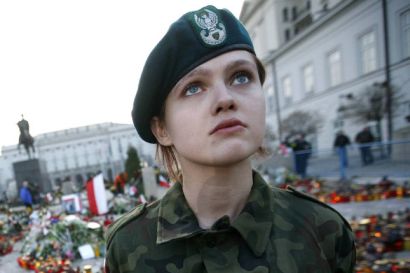
Inconsolable:
A young member of Poland's Presidential Palace
guard
stops for a moment of mourning in Warsaw, April 12.
This tragedy, this grief and sense
emptiness, cannot be removed. Not yet, not on this sad Saturday. But I've
talked a number of times with some of those who died on their way to the ceremony
in Katyn. I knew Andrzej
Przewoźnik, Sławomir
Skrzypek, Jerzy
Szmajdziński and, first of all, Mariusz Handzlik, the guiding
spirit of president's foreign policy. I think that all of them, along with
President Kaczyński and the others, are watching this from above. And they
are happy that this is the way the world is talking of Poland - about the
country for which they dedicated their lives and, ultimately - sacrificed them.
Perhaps at least in this way,
the terrible catastrophe near Katyn will begin to make sense, as well as this
sad, this terribly sad, Saturday.