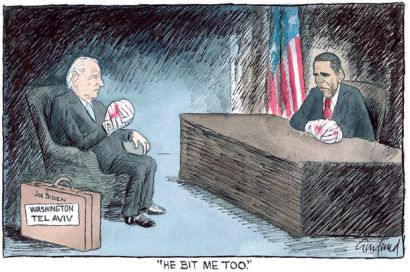
"Against
the backdrop of unprecedented escalating tension between the U.S. and Israel … one
can envision a scenario in which Israel puts it all on the line, possibly in the direction
of Iran. The U.S. would have no choice but to support its time-tested friend. Obama
may now have the opportunity to illustrate in practice the legality of 'just' wars."
Israeli Prime Minister Benjamin Netanyahu: When his government announced plans to build 1,600 new homes on what is widely percieved to be occupied Palestinian land in East Jerusalem, it was a major slap in the face to visiting Vice President Joe Biden.
The Moscow meeting of the
Middle East “Quartet” [the U.N., U.S., European Union and Russia] is a
status-event, but not a life-changing one. The fact of the arrival of the world's
leading diplomats is compensation for the Middle East peace conference Moscow
never hosted but which Smolenskaya
Square [Foreign Ministry] has been working toward for two years. Although
lately, the idea has been mentioned less and less often. And it's clear that
this forum of pomposity, even if it comes off, won’t bring results, since the
situation in the region isn't even favorable for a well-thought out dialogue -
let alone peacemaking. One previous such meeting near the closing curtain of
the Bush Administration and organized in Annapolis ended in nothing, even if
the White House and State Department seem to have put in a serious effort.
The meeting of the “Quartet”
allows Russia to remind everyone that it remains one of the key intermediaries,
and that it can provide the opportunity for back room conversations, for example
about Iran, or the latest nuances of the START II Treaty. And in any case,
there was little pressure for a breakthrough - no one expects miracles in the
Middle East peace process.
Then out of the blue,
something happened: The meeting in Moscow is being held against the backdrop of
unprecedented escalating tension between the United States and Israel. When the
Israeli Interior Ministry announced expanded construction in Jewish
neighborhoods of East Jerusalem during Joe Biden's visit, the U.S. government
considered it an insult. Biden had come to launch indirect talks between the
two sides. And although Prime Minister Benjamin Binyaminhastried to lessen
the impact by promising to get to the bottom of why the unfortunate announcement
was made, he has failed to relieve the tension. Now Barack Obama can use the
situation to put pressure Israel.
Immediately after the elections,
the new Democratic administration began trying to adjust the traditional
approach of the White House, which, essentially, consists of one-sided support for
Israel. Even during the campaign, Obama had to convince Jewish voters that he's
committed to the security of its chief Middle East ally. Influential
organizations were suspicious of the candidate, who was brought up in
Indonesia, and bore the middle name Hussein. Back then he managed to dispel the
mistrust, but then the fears began to look justified.
Barack Obama and his
strategists really believe that to achieve success in the Middle East diplomacy,
the United States should take a step toward the Arab world, especially after
Bush completely ruined the relationship.
(This is something that Zbigniew Bzerzhinsky,
in particular, never tires of writing, and he is considered one of the
instigators of this administration's foreign policy) Obama’s Cairo speech,
which is considered the best of his policy speeches, though it reflected tried
and true accents, contained a curtsey to the Arab world that caused anxiety in
Israel.
Americans and Israelis are
terribly unhappy with one another. Israel is extremely disappointed by the fact
that Washington didn't greet more warmly Netanyahu's public consent to the
coexistence of two states - Israeli and Palestinian. For the very right-wing
cabinet that constitutes Israel's current government - this was a huge
concession - which, according to the Israelis, Americans appreciated little and
took it as a given. The White House, for its part, is frustrated by Israeli
intransigence on the issue of settlement construction.
The United States hinged
further talks on a cessation of settlement activity - and the Israeli authorities
rejected it categorically. As a result, U.S. efforts greatly diminished by the
end of last year. Moreover, the administration was forced to back off and
soften its demands. This, in turn, not only disappointed Arabs, it raised sharp
questions about Obama's credibility and capacity to withstand the Israeli onslaught.
True, some commentators have
already suggested that the administration isn't simply going to back down. The series
of events during Biden’s visit gives Washington a chance to go on the offensive.
To put a superpower's second-in-command in such an embarrassing position is a
bold step, regardless of the substance of the issue - and it must be paid for.
It's no accident that U.S. friends of Israel are making Herculean efforts to
soften the impact.
Israel can chart an
independent course, but at the end of the day, its very existence in hostile
surroundings depends entirely on American support. Now Washington has an
opportunity to depict itself as terribly insulted, and make it clear to Israel
that assistance isn't unlimited or unconditional.
The insult inflicted on
America also makes the U.S.-Israel lobby slightly more vulnerable, although
seriously undermining its position is hardly realistic. Obama badly needs if
not a success, then at least the absence of failure. In response to the
situation, Netanyahu may be forced to change course to lead the Middle East
peace process out of its current dire condition, if only temporarily. Moreover,
the other members of the Quartet are inclined to support this. Europeans are furious
because Israeli Special Forces are suspected of organizing the assassination of
a Hamas leader in Dubai - and using fake E.U. passports. And Russia has always
thought that Washington isn't hard enough on Israel.
The Israeli government has
room to maneuver, but it's extremely limited. The Likud coalition could easily
fall apart, and Israeli public opinion isn't leaning toward peacemaking. Besides,
the question of negotiations depends on the split of the Palestinian leadership
and the territory itself - Gaza remains under the authority of Hamas and Fatah
controls the West Bank. Mahmoud Abbas' chances for compromise are also very limited.
But at the same time, many say he's the only Palestinian leader capable of reaching
a deal with Israel - and that any of his successors will be far more radical.
Posted
by WORLDMEETS.US
In this situation,
hypothetically, one can envision a scenario in which Israel puts it all on the line, possibly
in the direction of Iran. The diplomatic process over Teheran's nuclear program
is stuck. There is talk of imposing sanctions, of which in fact, everyone is
afraid - and it's unclear what to do if they fail. Israel has repeated numerous
times that it won't wait indefinitely for the international community to decide
on something, since it sees Iran as a threat to its existence.
Israeli military action
against Iran's nuclear facilities would lead to a sharp deterioration in the
region, and the United States will have no choice but to support its time-tested
friend - against both Iran and its allies Hamas and Hezbullah, which will likely
be used by Iran to deliver an asymmetric response.
Such a scenario is fraught
with unpredictable consequences - but this constantly tightening knot of
contradiction disguised as a diplomatic effort will sooner or later lead to an
explosion. So Barack Obama may now have the opportunity to illustrate in
practice the speech he made upon accepting the Nobel Peace Prize, in which the
president defended the legality of “just” wars.
* Fyodor Lukyanov is Chief
Editor for Russian in Global Affairs