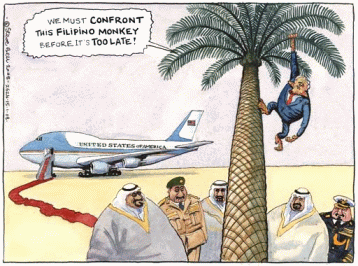
[Guardian Unlimited, U.K.]
Frankfurter Rundschau,
Germany
Bush's Message Fails to Take Hold …
"As in the rest of the Arab world, Bush no longer has any
credibility. … Riyadh is ready to recognize Iran as an equal and equivalent
mid-sized power in the region. Which is exactly what the United States and
Israel want to prevent, but without knowing how."
By Michael
Lüders

Translated
By Ulf Behncke
January
18, 2008
Germany
- Frankfurter Rundschau - Original Article (German)
On Sunday, the Arab news station Al-Jazeera broadcast live U.S.
President George W. Bush’s keynote address on his trip through the Gulf States.
In Abu Dhabi, capital of the United Arab Emirates, he warned against the
“world’s leading sponsor of terrorism,” Iran. At the same time, he spoke of the
“message of freedom” for which his country stands.
The handpicked audience, including the entire leadership of the
United Arab Emirates, offered their polite applause - but afterwards the speech
was no doubt neatly filed away - and not only because President Bush is
regarded in the Gulf States as a discontinued model and a "lame
duck." As in the rest of the Arab world, he no longer has any credibility.
The difficulties in Afghanistan, the disaster in Iraq, a peace process between
Israelis and Palestinians that doesn't deserve the name: the leadership of the
Gulf States and their general publics hold the policies of the Bush Government
responsible.
Against this backdrop, the “message of the freedom” isn't catching
on. Although Iran’s radicalism-prone Shiite leadership is anything but popular
with the Sunni-ruled Gulf States, even Washington’s obsession with Teheran
isn't shared by them. For Saudi Arabia - Iran's great rival for leadership of
the Islamic world - it is crucial to focus not on continued confrontation with
Tehran, but on coexistence. In other words: Riyadh is ready to recognize Iran
as an equal and equivalent mid-sized power in the region. Which is exactly what
the United States and Israel want to prevent, but without knowing how.
The Gulf States are Iran’s immediate neighbors.
They fear nothing more than another war that would further destabilize the
region. Added to that are the close economic ties between
Iran and the Gulf States. More than half of Iran's foreign trade beyond
oil and gas is flows through the ports of the Emirates. Hundreds of thousands
of Iranians live in Dubai and Abu Dhabi alone. This close economic
interdependence is another reason Teheran has increasingly ignored Washington’s
saber rattling.
The Gulf States are very conservative.
They attach great importance to good relations with the United States, upon
which they depend for their defense. They would never aspire to break with
Washington. Instead, they - and especially Saudi Arabia - are altering their
foreign policies away from unilateral dependence on Washington. The Russian
government is currently experiencing a charm offensive from the Gulf countries;
while China and India are also being courted. The goal is to balance the
hegemonic influence of the United States without openly criticizing this major
ally about exercising more restraint.
A true master in the art of this
political balancing is the ruler of Qatar, Sheikh Hamad
Bin Chalifa Al-Thani. On
one side, he has given over almost the entire western half of his country to
U.S. forces. From there, the wars in Iraq and Afghanistan are coordinated. On
the other hand, in 1996 he launched the Al-Jazeera news channel, which can
hardly be regarded as U.S.-friendly.
Click Here
for German Version







 [LATEST NEWSWIRE PHOTOS: President Bush's Middle East Tour].