[The Economist]
[Click here for jumbo version]
Frankfurter
Allgemeine Zeitung, Germany
Suspicion of
Government Threatens the United States
"Distrust
of the state is an American founding principle. But this federation in which
people expect strong leadership and a willingness to embrace pragmatic
solutions cannot exist without trust."
By Klaus-Dieter Frankenberger
Translated By
Stephanie Martin
January 4, 2011
Germany - Frankfurter Allgemeine Zeitung - Original
Article (German)
In fact, it's the ideal
envisioned by the American Constitution: Political power is not concentrated
but distributed - and is therefore limited. The distrust of political authority,
of government and thus of the state, is a bedrock and enduring principle of the
United States. This finds reflection in the separation and interdependence
of powers. Rather than seeking the efficient exercise of power, power is circumscribed
and restricted.
So if in the next two years, Democratic
President Obama confronts a Congress in which at least one chamber, the House
of Representatives, is dominated by Republicans, then it will be entirely in keeping
with the liberal intentions of the 18th century Founding Fathers, who feared
nothing as much as tyranny of the majority. And it also corresponds with the
wishes of many voters, who feel that "divided government" is always
better than a situation in which both the president and Congress come from the
same party, which allows an agenda to be pushed through without opposition.
From a constitutional perspective, the type of single-party government we’ve
seen in recent years is just as undesirable today as it was in the 18th century.
AN ENEMY THAT MUST BE CONQUERED
But whether it's an issue of a
historical ideal or present-day reservations, the fact that the November Congressional
elections strengthened Republicans, who are now in control of the larger
chamber and are able to drive Senate Democrats even
further into a corner, is widely viewed with pessimism. Standstill, paralysis, blockade
- this is the direction most forecasts are taking, which largely has to do with
the sharp ideological polarization between Democrats and Republicans in recent
years (which mirrors a general public segmentation into different political and
cultural environments). There is bipartisan cooperation, and even President
Obama found support in the "enemy camp" when he was really looking
for it. His successes before Christmas prove that cooperation is possible. But
desire and willingness to compromise are in very short supply - and the style
has become rough.
[The Economist]
[Click here for jumbo version]
The political opposition is
treated as an enemy; not one to govern with, but one that must be conquered. Many
Democrats exhibit cultural snobbery in their judgment of Republicans, who in
turn have many in their ranks who have succeeded with hard-hitting slogans
against "Washington" and who only want one thing: To drive Obama from
the White House. These aren't favorable conditions for bipartisan cooperation.
Posted by WORLDMEETS.US
It’s true that there is
something to be gained from a period of "stagnation": party politics
at the extremes will be avoided. Meanwhile, it won't lead to resentment on the
part of the party that's been run over, which would otherwise cause them to seek
revenge at the next opportunity. On the other hand, Obama can govern for some
time against the Congress, but he needs support for his concerns. Consequently,
he needs Republican support. Obama will be obliged to make more concessions
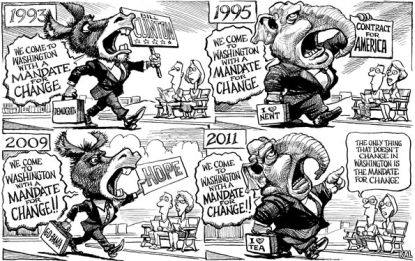
than ever, even if it incurs the wrath of Democrats on the left. In general, he
must regain an independent footing. In spite of his end-of-year rally, the
preacher of change is far from the inspiring heights of 2008.
Republicans, for their part, will
think twice about applying the brusque prevention tactics they've become accustomed
to, and with which they have fueled the frustration of the people. As a quasi-majority
party, they also bear more responsibility. At least that’s the view of lots of
voters, who condone neither the extreme of an arrogant exercise of power nor venomous
confrontation.
The next presidential
election is just under two years away, with the campaign season beginning in
six to eight months. At that point, policy will focus solely on what allegedly
matters - or doesn’t matter, to the electorate, which will also determine the tone.
It would be desirable to have a president capable of working with his
Republican opponents despite his desire to run for reelection. It’s not as if
all Americans were in good spirits and the country was riding confidently toward
a new dawn. Dissatisfaction with government and its institutions is as
significant as the uncertainty about the course of the country. And it's not
only his enemies who see America's crisis of identity. Its position in the
world, for example, is not what it was 20 or 50 years ago.
Distrust of the state is an
American founding principle. But this federation in which people expect strong
leadership and a willingness to embrace pragmatic solutions cannot exist
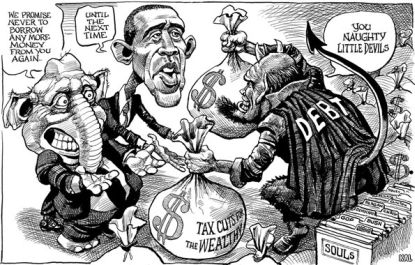
without trust. Two years of paralysis - this would further erode confidence in
government. To ignore central issues like government debt - that would be more
than negligent. It would be a cynical gamble that puts the country’s future at
stake.
CLICK HERE FOR GERMAN VERSION
Powered by Disqus
[Posted by WORLDMEETS.US January 7,
12:50am]