[The
Telegraph, U.K.]
Folha, Brazil
A Crisis and
Bailout that Greatly Advance the Capitalist Cause
"That liberal George W.
Bush and his Treasury Secretary, Henry Paulson, a former executive at Goldman Sachs,
are leading state interventions into the icons of Wall Street. The message
isn't 'state intervention is the solution,' but 'we are pragmatic, we are not
sectarian, we are going to intervene when necessary.'"
By Sérgio Malbergier

Translated By Brandi Miller
September 18, 2008
Brazil
- Folha - Original Article (Portuguese)
The current financial crisis
is quite different from the others. It's much more global and much faster. But,
contrary to those Cassandras  who still cry about the end of history and the
consolidation of the market economy as the most capable way to organize
production efficiently and progressively, the current crisis doesn't weaken
capitalism. Rather, it strengthens it.
who still cry about the end of history and the
consolidation of the market economy as the most capable way to organize
production efficiently and progressively, the current crisis doesn't weaken
capitalism. Rather, it strengthens it.
[The God Apollo is said to
have given Cassandra [daughter of the king of Troy] the gift of prophecy. But
because Cassandra rejected Apollo's romantic advances, he cursed her by making
it so that no one ever believed her ].
The greatest evidence of this
force is that the United States of liberal George W. Bush and his
Treasury Secretary, Henry Paulson, a former executive at Goldman Sachs, are
leading state interventions into the icons of Wall Street. The message is not
“state intervention is the solution,” but “we are pragmatists, we are not
sectarian, we will intervene when necessary.”
What we're living through
today is another chapter - part of the cycle of crises of the capitalist
system, this halt to an explosive stew of cheap and abundant credit, extreme
advances in engineering, the deregulation of the financial markets, and the
large capital reserves of Asian and oil-producing countries in search of
securities to invest in.
After the weakest link in
today's global financial chain came undone (low-quality loans for property in
the U.S., called subprime), the system collapsed.
There's already a consensus
that major deregulation of the U.S. markets perhaps allowed for criminal
excesses from the Wizards of Wall Street. The “Masters of the Universe,” so
well and ironically portrayed by Tom Wolfe in his unforgettable The Bonfire
of the Vanities, are now paying the price: losing their jobs, their
multi-million dollar bonuses, their winning auras … and their banks.
Posted by WORLDMEETS.US
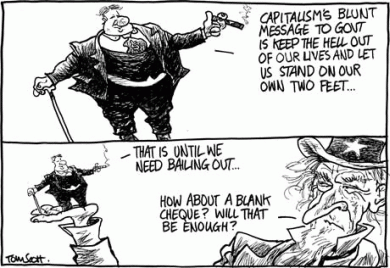
[Stuff, New Zealand]
But there's no alternative to
the liberal economy, as bad as that may seem and as Francis Fukuyama prophesied
in the 1990s. The examples are everywhere. China, for example, has advanced
both because it has set aside economic centralism and becasuse it has embraced
capitalism, as has India, Brazil, Ireland and Africa.
Capitalism is now refining
and perfecting itself. There will be an increase in markets regulation until
new advances in financial engineering overcome it in search of greater profits,
generating the next crisis. Such is the way of humanity.
As Marx and
Engels put it in their 1948 Communist Manifesto, in less than a century
the capitalist system, "has created more massive and more colossal
productive forces than have all preceding generations together."
Or to paraphrase Churchill,
capitalism is the worst economic system ever invented, with the exception of
all others that have been tried before.
The alternatives are North
Korea, Myanmar, Cuba, neo-Czarist Russia, Chavez's Venezuela, moralistic
Bolivia … I prefer New York.
Posted by WORLDMEETS.US
|
|
Sérgio Malbergier is the editor of the Money section of the
Folha de S. Paulo. He was the editor of the World section (2000-2004),
a correspondent in London (1994) and sent as a special correspondent to
countries like Iraq, Israel and Venezuela, among others. He has directed two
short films, A Árvore [The
Tree] (1986) and Carô no Inferno [Carô in Hell] (1987). He writes for Folha Online
on Thursdays.
E-mail: smalberg@uol.com.br
|
CLICK HERE FOR PORTUGUESE
VERSION
[Posted by WORLDMEETS.US
September 20, 11:29am]