"Many will benefit from America's
disaster in Iraq, but not the West nor the cause of human rights and democracy.
One regional beneficiary is Iran, but the global winner is China. While the
the leading Western power fritters away its credibility and
power in the so called "war on terror" - read: against large portions
of the Islamic world - China grows strong in the wake of its strategic foolishness."
The Olympic Games ended with
an impressive "show of force" by the People's Republic of China. With
its 51 gold medals, China not only won first place among participating nations;
with its presentation of these Games it demonstrated to the entire world its
progress and its power.
Perhaps one day in retrospect
we'll assess that this demonstration of Chinese power has been one of the few "honest"
results of the 2008 Olympic Games. In fact, China is taking huge strides to
being a world power, and American policy has had more than a little to do with it.
Coinciding with China's Olympic
demonstration, the West slid into a confrontation with Russia over the war in
the Caucasus;a confrontation that
proved a strategic impasse for both America and Europe as well as Russia.
With his Iraq policy, George
W. Bush maneuvered the West into its first strategic impasse. The U.S. has dissipated
its power and credibility, so that finally - if all goes well! - it will leave
behind a status quo that is difficult to sustain and leaves Iran as the new hegemonic
regional power. Bush's political legacy is a confrontation between the West and
the Islamic world, the end of which is not yet in sight.
One can only
imagine where the world would be today if the U.S., after September 11 2001 - as
the majority of the world population stood beside her morally and politically -
had begun a multilateral effort to resolve the conflicts in the Middle East and
combat poverty and corruption. George W. Bush allowed this historic opportunity
to be missed.
Many will benefit from America's
disaster in Iraq, but not the West nor the cause of human rights and democracy.
One regional beneficiary is Iran, but the global winner is China. While the
United States, the leading Western power, fritters away its credibility and
power in the so called "war on terror" - read: against large portions
of the Islamic world - China grows strong in the wake of its strategic foolishness.
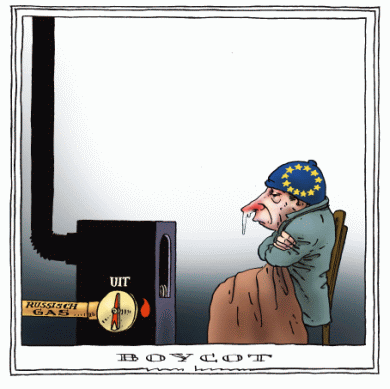
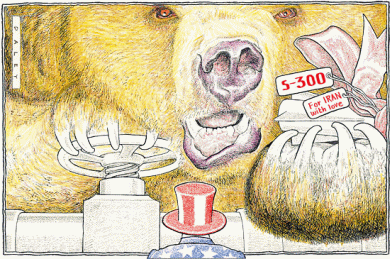
Now the West is in danger of maneuvering
into another impasse: a confrontation with Russia over the Caucasus. And to
this as well, little grief will be felt in Beijing.
The United States will soon choose
a new President, and election campaigns are seldom characterized by strategic clarity.
We'll have to wait and see how much campaign rhetoric and how much strategic conviction
is expressed by the candidates. As an observer, however, one can't avoid the impression
that a tendency toward a confrontation with Russia prevails. If this comes
about, the political and strategic folly of the Iraq War will be multiplied many
times over.
Neither the West nor Russia will
obtain anything positive from this. On the contrary, the common interests of
Russia and the West demand a new era of cooperation. Russia's strategic
challenges come not from Europe or America, but from the Far East and the Muslim
south - and in the latter, Russia has something in common with the West.
Actually, these common challenges should be the top priority for both sides,
but they are not.
RUSSIAN NEWS REPORT ON THE 'AMERICANIZATION' OF GEORGIA
Instead, the Russian
leadership intends to rebuild its prestige as a world power by returning to great
power politics vis-à-vis its smaller neighbors, which is short-sighted. None of
the many strategic problems nor Russia's internal weakness can be resolved this
way.
Certainly, Russia's return to
great power politics toward its neighbors can never be acceptable. The fear of
Russia's neighbors, formerly of the Soviet Union or Warsaw Pact, are
understandable and must be taken very seriously.
The answer to Russia's great
power behavior should not consist of short-sighted prestige politics that
merely whitewashes the West's weakness. Instead, what is needed a strengthening
of the transatlantic alliance [NATO] and especially the E.U. as well as a clear
answer to the question of what Russia's role in Europe should actually be.
Posted by WORLDMEETS.US
CONTRARIAN JOURNALIST ALEX JONES ON RUSSIAN NEWS, AUG. 26
It was the critical error of
Western policy that after the conclusion of the first major rounds of NATO and E.U.
expansion, that this question was never really asked or answered. Can there be a
European order that takes seriously both the justified fears of Russia's
neighbors as well as the interests of Russia - and which recognizes Russia as a
European power that must be equally involved in the European system?
If both sides fail to answer this
crucial question and avoid approaching this hopeless confrontation, both Russia
and the West will have a very great strategic price to pay. Other will then
once again rejoice in silence.
*Joschka Fischer was
German foreign minister and Vice Chancellor in the government of Gerhard
Schroeder from 1998 to 2005.