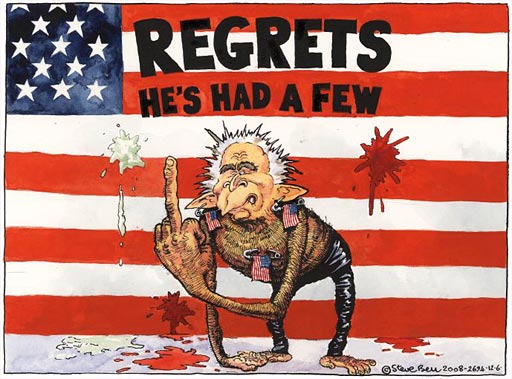
[Guardian Unlimited, U.K.]
Die Zeit, Germany
As Bad as Bush
Was, Europeans Hardly Helped
"What most people know but
prefer to overlook is that it wasn't one man alone who widened the gap between
the two sides of the Atlantic, and that the bogeyman Bush often either approved
or facilitated Europe's own decisions."
By Joachim Fritz-Vannahme*

Translated By James Jacobson
June 11, 2008
Germany - Die Zeit - Original Article (German)
Paris, London,
Berlin in a pig's gallop, yet also a detour to the Slovenian Idyll of Brdo - George W. Bush’s farewell tour through half of
Europe differs little from the tours taken by American tourists visiting the
Old World. Today the polls announce that about 80 percent of Europeans are
opposed to the policies of this president. "The man," reasons former
Foreign Minister Hans-Dietrich Genscher, "has done everything possible to
widen the chasm between the U.S. and Europe.”
What most people
know but prefer to overlook is that it wasn't one man alone who widened the gap
between the two sides of the Atlantic, and that the bogeyman Bush often either
approved or facilitated Europe's own decisions.
Always
economically, but also in the social sphere and even in foreign policy, the
dramatic transformation of the United States has been more accompanied by Bush
than promoted by him: The end of the Cold War saw the dawn of the Pacific era.
America sits astride the Pacific and therefore is party to it. With or without
Bush, transatlantic relations would necessarily have shaped America's worldview
far less than in the past.
And neither John
McCain nor Barack Obama has criticized the politically-motivated arms build-up
of the Bush warriors: This country buys almost half of the world's weapons for
the unimaginable amount of half a trillion dollars - and it still hasn't
managed to make the planet as safe as its fear of the rest of the world
demands. If we are to believe the candidates who aspire to succeed Bush, this
enormous waste isn't going to change. Because the American
"home front" has bought into an economic cycle that follows its own
logic.
But let’s talk of
the Europeans, who will shed no tears for George W. Bush. Our security today is
"being defended in the Hindu Kush [Afghanistan]," to quote former
German Defense Minister Peter Struck. But do we do it out of conviction or even
strategic thinking? … or is it rather to demonstrate
loyalty to the often-invoked [NATO] Alliance?
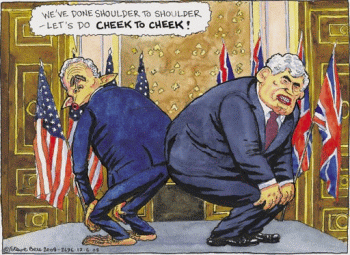
[Guardian Unlimited,
U.K.]
The Iraqi War has
made the Near and Middle East more unstable than ever,
and this is an allegation that even Bush can no longer deny. Thus former
Foreign Minister Joshka Fischer was right when he
said, “I'm not convinced that this momentous campaign will be the right
one." However, self-satisfaction is of little help and there's very little
reason to gloat: How do Europeans want to handle the regional crisis in the
Middle East or do more than just talk to Iran?
If it's true that
Bush so blissfully did wrong, the Europeans didn’t even ask what the right
thing would be. Our dealings with Russia and China remain difficult and even
precarious, Africa has only recently entered our field of vision, and little by
little, Latin America has again become terra incognita: The European practice
of global politics hasn't gotten results in a very long time.
Posted by WORLDMEETS.US
We lead the pack
in holding a peaceful dialogue, which is the motto of the Europeans. That’s
good since after all, this was once a continent of all-out war. But this part
of the world (and by this we mean the 27 members the European Union) should
occasionally pause to ask: Is a peaceful dialogue the goal, or is it to find a
reasonable way to deal with a complex world? Is European multilateralism in a
multi-polar world the answer - or is it a matter of searching out whether it's
possible to secure our interests and represent our values with other-than
military means?
George W. Bush
didn’t listen, throwing all wisdom and caution to the wind. Meanwhile, the
Europeans talk to almost all parties, particularly those that no longer have
Washington's ear. The deafness of the man in the White House led him down a
path of global political self-deceit. But his European critics should be wary
of snap judgments: George W. Bush’s self-deceit does little to improve European
long-term planning.
*Joachim Fritz-Vannahme, a long-time Die Zeit
editor, is the European project manager for the Bertelsmann Foundation.
CLICK
HERE FOR GERMAN VERSION
[Posted by WORLDMEETS.US June
18, 2:24am]






 [LATEST NEWSWIRE PHOTOS: President Bush in Europe].