"It's an absurd play being
staged at the White House. All the actors who have come to Washington know that
the prospect for a peace agreement in the Middle East is as realistic as the
sight of a swarm of flying camels in the Antarctic."
The failure of negotiations
between Israel and Palestinians was followed by violence much like the "Amen"
follows a prayer.
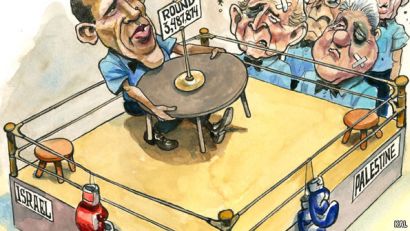
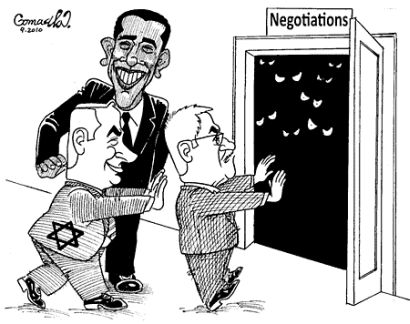
It’s an absurd play being
staged at the White House. All the actors who have come to Washington know that
the prospect for a peace agreement in the Middle East is as realistic as the
sight of a swarm of flying camels in the Antarctic. But the two main actors,
Israeli Prime Minister Benjamin Netanyahu and Palestinian President Mahmoud
Abbas, are playing along anyway, for the director, U.S. President Barack Obama,
who so dearly wants this show. Before the curtain even lifted, he even received
a prize for this: the Nobel Peace Prize. And such a distinction naturally obliges
one.
Talking is better than
shooting, they say. It's hard to argue with that. But when the talking goes
nowhere and the shooting gets even worse afterwards? This is precisely what
happened ten years ago. The American "Fix It Man" back then was Bill
Clinton. Over to Camp David he dragged the Israeli prime minister at the time
and current defense minister, Ehud Barak, as well as the late PLO supremo Yasser Arafat, to force them into a peace
settlement. The talks were ill prepared and failed.
This was followed by an
outbreak of violence - the Palestinians' Second Intifada. Barak
lost the election. Ariel Sharon came to power. And inexorably, he answered the
terror. Sharon finally had a wall erected to ward off attackers. Hope flared
when he withdrew the army from Gaza, but that vacuum was filled by the
radically-Islamic Hamas. The Gaza Strip became a launching pad for missiles that
rained down on Israel, until the Israeli army counterattacked with a three-week-war during the
winter of 2008-2009.
The flop of Camp David weakened
moderate forces on both sides. Israel’s political landscape has since shifted
to the right. Today Arafat’s successor, Mahmoud Abbas, presides over only a
small patchwork of land on the West Bank. The Gaza Strip is controlled by Hamas.
That alone makes a two-state solution virtually impossible. For there is in
fact a third state: Hamastan. Radical Islamists showed
what they think of the Washington peace summit before the talks with an attack
on the West Bank, which killed four Jewish settlers. Now the peace proponents
shouldn’t be deterred by the fundamentalist naysayers. The problem, however, is
that a political will for peace is not enough.
Even if Netanyahu, who some may
have forgotten, despite his hard-line rhetoric, agreed to concessions to an
agreement that included concessions to the Palestinians (namely in the 1998 Wye
River Memorandum), it's hard to imagine that of all people, he will bring
about peace. For Netanyahu to be persuaded to freeze Jewish settlement
expansion, at least for a while, Obama had to practically conjure up a crisis
in Israeli-American relations. That deadline expires on September 26 - which
will also serve as the first test of the new peace process. If Israelis again expand
their settlements, then Palestinians will stop negotiating. If Netanyahu
extends the moratorium, he will lose Foreign Minister Lieberman and his
coalition will disband. In that case, he could bring in the moderate opposition
- the Kadima Party - which would benefit prospects for
peace. But the question will remain if and what kind of peace Netanyahu
wants.
However, it’s also doubtful
whether PLO leader Abbas is strong enough for compromise. In his negotiations
with Netanyahu's predecessor Ehud Olmert, he was dealing with a more open
counterpart. Olmert offered him a land swap, a division of Jerusalem, a
solution to the refugee issue - the full range of a peace agreement, the outlines
of which at least on paper have been clearly defined for years by all the participants.
But the agreement never came. Why should it now work with Netanyahu, who before
the start of talks called Jerusalem the indivisible capital of Israel and who
would never go as far as Olmert did?
Obama is acting more courageously
than any previous U.S. president, all of whom waited until the end of their
terms to touch the hot iron of the Middle East. But he has awakened in an unfavorable
constellation and has instilled exaggerated hopes which could morph into bitter
anger. A flight school for camels would sooner succeed than his dangerous peace
farce.