"All people, especially in the
Arab and Islamic world, long to see Democratic candidate Barack Hussein Obama
win, occupy the chair of the American President and replace Republican Bush at
the helm of the United States."
Berlin's Victory
Column: A very symbolic and perhaps fitting place for Barack Obama's
much-awaited speech on translatlantic relations - although not all would
agree. .
All people,
especially in the Arab and Islamic world, long to see Democratic candidate Barack
Hussein Obama win, occupy the chair of the American President and replace
Republican Bush at the helm of the United States.
The way Obama
absorbed the inside of America during the primaries is reflected in his
compelling campaign slogan (change). In the same way, his intellectual assets
and his Muslim origins have allowed him to absorb the thinking of many Arabs
and Muslims, notwithstanding his subsequent assurances that he isn't Muslim,
which is a position taken for political purposes only. Obama has also absorbed
global public opinion on his world tour, during which he visited several
countries and offered his suggestions in regard to the world's central
problems, including wars into that the current American administration plunged
the United States into - and which the Europeans should have nothing to do
with.
The entire world
awaits Obama, considering him a good man to replace an "evil" one. It
is Bush who has prepared the ground for Arab and Muslim religious and social
support for Obama, a man who may find it possible to look at their problems
differently than other presidents, especially Bush. In Obama's racial origins,
skin color and youth, Africans and Asians find in him someone that they hope
will ease their economic concerns and be more in tune with the distortions of
American foreign policy - and the incapacity of the
"neo-conservatives" to solve them.
It is commonplace
to have U.S. presidential candidates become the focus of world public opinion
and controversy. It's to be expected that they become the center of attention
for newspapers, analysts and other politicians. But in Hussein Obama's case,
almost everyone has gathered around him and considers him a possible world
savior. This is because his beliefs are opposed to those of the
"neo-cons" and their activities on the ground - and McCain, the
Republican candidate to succeed a man [Bush] who's unpopularity reflects the
dimension of exasperation and fatigue that people feel due to the events of
recent years.
After eight years
of war and the threat of war, Obama's speeches on foreign policy have already
brought relief to the world. He intends to devise new methods for dealing with
controversial global issues which have been addressed with nothing but force
since the arrival of the neo-cons to power in Washington.
Obama has
stressed in more than one occasion that he will continue to fight terrorism.
But he intends to do so with instruments beyond those of security and the
military - a strategy which has given bin Laden and his followers the capacity
to recruit more members. Obama has said he will pursue models of social
development alongside security and military solutions, and focus specifically
on Afghanistan, which he considers the place where terrorism is growing the
most.
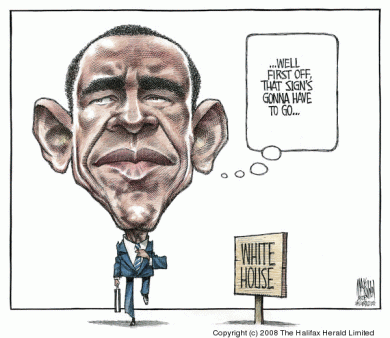
In the event of Obama's
arrival at the White House, many question these justifications for optimism -
particularly Arabs and the Muslims - both in view of the nature of U.S.
government institutions and the fact that the president just executed its
policies; and because of past experiences and disappointments that Arabs and
Muslims have had with previous American Presidents. Backing up their
skepticism, many cite Obama's position on Israel and his speech to the
American-Israel Public Affairs Committee. But I would suggest that this
shouldn't alter our expectation that Hussein Obama possesses a vision that is
completely different from Bush's - a man who has disappointed America even more
than he has people of other countries, and he continues to do so.
OBAMA PLEASES ISRAEL, ANGERS
ARABS AT AIPAC
The problem lies
in a lack of Arab proficiency in the art of using the "leverage" card
to obtain their demands. It's true that American foreign policy contains red
lines that no one is allowed to cross, but experts say that if the Arab side
takes action, there is the potential to get the U.S. to adjust its policies. Of
course, Obama Hussein will not pursue a fundamental change in American foreign
policy. If he does reach the White House, it's a good bet that his first
decisions will prompt many who support him now to retract their favor for him.
But there is little doubt that he'll be less extreme and arrogant than
President Bush.