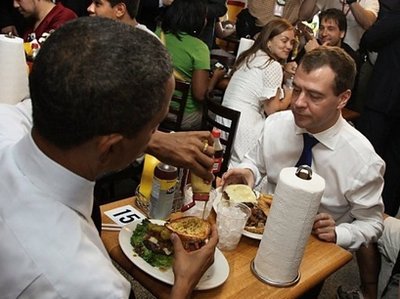
While President
Obama shared a burger with Russia's president
at Ray's Hell Burger
in Virginia, the Justice Department was preparing
to out a large
Russian spy network operating in the United States.
Ta Kung Pao, Hong Kong
The First of Many Russo-American Spy Scandals
What does the recent scandal
involving ten Russian spies uncovered in the United States tell us about
post-Cold War espionage? According to this article by Shi Jun-yuofHong Kong's
Chinese-language Ta Kun Pao, while the end of the Cold War may have
concluded open U.S.-Russia hostilities, the 'art' of espionage continues to
play out on new terms, as does the struggle between the two powers.
Alleged Russian spy Anna Chapman: Arrested with ten others on June 27, Chapman and her associates have been returnbed to Russia, where they have been undergoing extensive debriefing..
When the U.S. Justice
Department announced it had uncovered a Russian "spy network," a
global uproar immediately ensued. After a ten year investigation, ten spies
were arrested in one fell swoop - a number rare not only over recent years, but
even during the Cold War.
The leaders of Russian and
America, Obama and Medvedev, were just at the
G20 Summit sitting merrily opposite one another, conducting "hamburger
diplomacy." Then just a few days later, something so significant occurred
that zeroed out these events. It's incredible. No wonder even Russian Foreign
Minister Sergei Lavrov expressed confusion and
regret over what had happened: "No one told us what was about to occur.
All I can say is that the timing of events was particularly graceful."
Posted
by WORLDMEETS.US
Apart from being amazed,
people have begun to seriously re-examine American-Russian relations, hoping to
get behind the smiles and courteous language of the two presidents. The fact is
that "hamburger diplomacy" and "Spy-Gate" reflects opposite
angles of U.S.-Russia relations. Behind the relaxed facade, there is a contest
of strength, anticipation and attack - as well as deal making and comprise.
Although the two sides seem as incompatible as fire and ice, they have a kind
of organic unity, held together by a web of contradictions. This has been the
nature of U.S.-Russia relations in the past, and it remains so today.
Holding differing views isn't a strategy. The U.S. and Russia are like cars traveling on different roads
but due to common problems, end up driving in the same direction. During
the Cold War, the U.S. and Soviet Union established NATO and the Warsaw Pact as
rival spheres of influence, destined to confront one another until the bitter
end. This period also had its "Spy-Gates" when spies on both sides
were frequently uncovered. Exposing and expelling spies became as commonplace
as a homemade meal. But beneath clouds of battlefield smoke even during the most intense periods, under-the-table deals were still
cut. Perhaps it was deals like these that prevented World War III.
After the Cold War, the
United States didn't change its policy of suppressing and containing Russia.
Both sides remained rivals. Russia spared no effort in integrate itself into
Western society; but what they got in return was the eastward expansion of
NATO, "Color Revolutions" in Ukraine, Georgia and Kyrgyzstan, as well as U.S. military bases in Central Asia.
Russia strengthened its counterattack and successfully "de-colored"
Color Revolutions in Ukraine and Kyrgyzstan. But throughout the entire process
up to today, through conflict and compromise, the two giants walked down the
same eventful path.
The
sister and mother of Russian spy Tracey Chapman express
In the context of the past,
this incident would have had negative consequences on bilateral relations. But
the U.S. and Russia haven't resumed the Cold War. In this case, in the hopes of
minimizing the impact of the event on U.S.-Russia relations, the
U.S. backed off as soon as it could, and didn’t play it up in either government
statements or the media. On the Russian side, the Kremlin also reacted in a way
that demonstrates its desire to minimize the consequences. Academics blame U.S.
domestic politics and those reluctant to see the U.S. and Russia get too close
for the drama, which put President Obama in a tight spot.
Posted
by WORLDMEETS.US
In the modern world of
international relations, spying and the scandals it generates is a kind of art.
Spying having long deviated from its original role as a safeguard to national
security, spy scandals have become a political tool that governments use to
attack and discredit their opponents. Russia will certainly not take it lying
down that a spy network it maintained for over a decade has been destroyed. In
terms of when and how it will avenge the U.S. depends on Russia’s utilization
of the "art." The show has just begun and it seems that more
interesting scenes lie ahead.