Former Taliban Must Step Up and Help their Country
"They
use their Taliban connections to get elected to high office, but once in power
reject their own influence in their constituencies. They are
elected to represent the voters in the House of the People - but who are their
votes cast for? … Civilians and high-profile officials don't see the government
as their own. There is no will to fight and destroy the Taliban."
Marine General James Mattis will be the new head of the U.S. Central Command, replacing General David Petraeus, and ostensibly at least, Petraeus' new boss.
As Stanley A. McChrystal, top
U.S. general in Afghanistan, was being sacked due to disparaging remarks about senior
U.S. officials, Mr. Thomas L. Friedman, the great American columnist for The
New York Times,pointed
out an interesting and important issue about Afghanistan. Unfortunately, this
isn't a topic that has been focused on. In fact, for the past nine years both
in and out of Kabul, it has been conspicuously absent from the agenda. This
issue is ownership.
Ownership is everything in
business, war and diplomacy. People will fight with sticks, stones, and no
training at all for a government that they feel ownership over. When they -
Israelis, Palestinians, Afghans or Iraqis - take ownership of a policy,
anything is possible, most importantly, to quote Friedman, “that which gets
built becomes self-sustaining without us.” Of course, many Afghans agree with
him.
Within the structure of
Afghan government, there are certainly a number of so-called jihadis - as well
as political groups [such as members of the Northern Alliance] who
laid down their arms and both before and after the U.S.-led attack in 2001,
took part in the political process and confronted the
Taliban. No one ignores the fact that if foreign forces withdrew and the
Taliban resumed striking the government - as they certainly would - the same factional,
ethnic-based groups would reassert themselves, potentially forming multiple
fronts. Due to sharp differences in the influence of ethnic groups, the
anti-Taliban forces seem unable to reach consensus and form a unified front.
And even if this were to
occur, it wouldn't be the end of the story. Many in government would return to
their old friends and followers, who very often once commanded them.
Undoubtedly, they would be welcomed back, because what's important in
Afghanistan is sectarianism, tribalism, language, religion, and ideology. A few
years of weakly-applied democratic values and mechanisms haven't dealt a great
enough blow to stem the revival of the old factionalism.
Seemingly, the sense of
ownership within these old factions is low or even absent. There are senior civil
and political officials and representatives in both houses of the Wolesi
Jirga [House of the
People], who have had close ties to Taliban militants - and even a few who
were famous Taliban commanders. So why can't they act? Why don't famed Taliban
commanders who have joined the democratic process help Afghan and foreign
forces better deal with the Taliban? The notion that they know nothing of
Taliban tactics is more than a little suspicious.
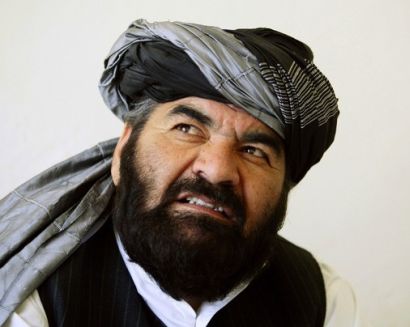
Abdul
Salam Rocketi: An ex-Taliban commander, recent presidential
candidate
and member of the Afghan legislature, why doesn't he and
other
ex-Taliban help the government settle affairs with the Taliban?
Take Abdul Salam Rocketi
for example: his nickname is derived from the word “rocket,” because of his
expertise and dexterity at firing them. Rocketi used to lead thousands of
Taliban militants, and served most of his life fighting both Soviet Forces and
his fellow jihadis after the Soviet withdrawal. Now he is with the Afghan
government. Last year he was a presidential candidate and was elected to the
Wolesi Jirga by a wide margin. Is one to believe that there is nothing he could
do to help Afghan Forces - or at least neutralize some deadly Taliban raids,
with the connections he enjoys to the anti-government militant leadership?
Rather, people like Rocketi
use their Taliban connections to get elected to high office, but once in power
reject their own influence in their constituencies. They are elected
to represent the people with votes in the Wolesi Jirga - but who are their
votes cast for? Who are the people that make up their constituencies?
Certainly, some of these areas are the most restive in the country -such as
southwest Afghanistan. If the voters elected them, can’t these lawmakers help
strike the militants more effectively? The insurgents are hiding within these areas;
they don't pop in from thin air! They cohabitate and live beside these voters. Meanwhile,
labeled as terrorist and terrorist supporters, civilians are sacrificed directly
and indirectly.
Posted by WORLDMEETS.US
Afghanistan is known around
the world as a cursed country, where people know nothing but fighting, violence
and bloodshed. As a consequence, huge numbers of civilians suffer under Taliban
influence - they are castigated, killed and murdered. Overall, it is they who
are the victims of the current war, which at least in the short-term has little
chance of easing. And at the same time, average people have no incentive to
help the government excise the Taliban from their territories. Why do
influential people like Mr. Abdul Salam Rocketi and Mullah Wakil Ahmed
Muttawakil not help Afghan security forces deal a blow to the militant
infrastructure? Many of these figures - and civilians, smugly reply that with
empty hands, they defeated the most powerful empire of the day - the USSR. So,
why can't they now remove a few Taliban guerillas who have stolen the wealth,
inflicted untold suffering and ruined the good names of the people?
Without a doubt, under a
stable political system they would enjoy their lives and live peacefully, but
they still aren't ready to sacrifice for a better future. So there must be
something missing. Thomas L. Freidman wrote that he simply didn't see an Afghan
“awakening” in areas under Taliban control. This is where the fault seems to
lie - under a lack of ownership. Civilians and high profile officials don't see
the government as their own. There is no will to fight and destroy the Taliban.
Such will must be encouraged,
and the people made to feel that they are fighting a war that above all is justified
under Sharia law. If such
a national-wide awakening emerges, there will be no need to train and augment
domestic security forces for the purpose of removing anti-government militants.
Civilians will do everything. Afghan civilians have tremendous experience
fighting - they have done so for decades.
*Jawad Rahmani is the
permanent writer of the Daily Outlook Afghanistan. He can be reached at jawad_rahmani2001@yahoo.com