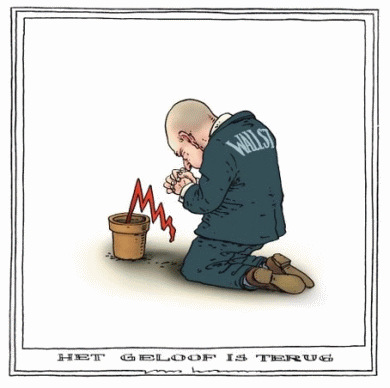
'THE RETURN OF FAITH'
[Het Parool, The Netherlands]
O Globo, Brazil
No Point in Complaining
that Credit Crisis 'Isn't Our Fault'
"A crisis of this dimension
knows no ideological boundaries, nor does it respect the idea of 'historical
justice' (this is pure rhetorical nonsense). It's futile to say, 'they are guilty, we
poor people did everything right and it's unfair for us to suffer."
By William Waack

Translated By Brandi Miller
October 3, 2008
Brazil - O Globo - Original Article (Portuguese)
In the chronology
of the current global crisis, this Thursday (Oct. 2) will probably go down in
history as the day it became quite clear that the catastrophe in the financial
system also got hold of the so-called real economy - and rapidly spread from
the United States and Europe to Asia and emerging countries, among them Brazil.
It is common to
use the term "contagion" to describe the process by which successive
economies contract, by virtue of negative expectations and due to the collapse
of the global credit system. But "contagion" suggests that it might
be possible to prevent the "disease," as long as the potential victim
remains isolated from the source of infection (in this case, the American
economy).
That's pure
nonsense, and it's dangerous, because it overshadows what must be done and delays
the adoption of protective measures. Do you want a recent example of how a
recession of global proportions affected even participants of a system believed
to a rival capitalism? The oil shocks of 1973 and 1979, which brought tremendous
damage to Western economies, also devastated trade between the Soviet satellite
countries with the capitalist world.
The illusion that
that a group of countries could live "independently" was quickly
destroyed. Some, like Poland, borrowed money from Western bankers. Others, like
East Germany, wanted to develop their own data processing by investing what
little they had in a lost cause. The implosion of the Socialist bloc had as one
of its deeper causes the incapacity of that system to compete on the global
scene.
Posted by
WORLDMEETS.US
This digression
through recent history serves only to highlight the fact that we can dispense
with the notion of "decoupling." The more advanced and competitive a
national economic system is, the more it will be affected by the crisis.
Therefore, it's Brazil the exporter and innovator which is connected with the
global economy which will face the worst consequences. And it is that modern
country - industry, agro-business, services and competitive exporters of
mineral commodities - that have ensured our prosperity so far.
Schadenfreude, a German word that has been adopted by
the Anglo-Saxon press, means to take pleasure in the misfortune of others. The
New York Times this Thursday pointed out the fact that many Latin American
leaders, among them Chávez [Venezuela], Morales[Bolivia],
Correa [Ecuador], Kirchner [Argentina] and Lula [Brazil], allowed themselves be
get carried away with schadenfreude in regard
to the crisis in the United States. And now, they're getting carried away with
fear.
Posted by
WORLDMEETS.US
A crisis of this
dimension knows no ideological boundaries nor does it respect the idea of "historical
justice" (this is pure rhetorical nonsense). It's futile to say "they are guilty,
we poor people did everything right and it's unfair for us to suffer."
Crises have another gloomy aspect: they make evident the vulnerabilities of
participants in the global economy.
I fear that the
international crisis will require us to make changes we didn't know how to make
when the tides of the global economy were blowing in our favor: tax reform,
political reform, improved education and the heavy investment in infrastructure
- in other words, address everything that increases costs and prevents the
nation of Brazil from being more competitive. And there is no consolation for
anybody to say that it's someone else's fault.
CLICK
HERE FOR PORTUGUESE VERSION
[Posted by WORLDMEETS.US October 8, 1:36Am]