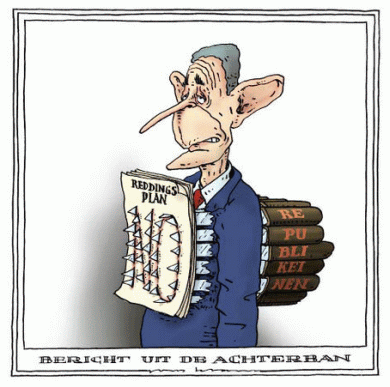
ON THE KNIVES IN BUSH'S BACK: REPUBLICAN
ON BUSH'S CHEST: EMERGENCY PLAN - NO
CAPTION: REACTION OF SUPPORTERS
O Globo, Brazil
Confronting 'Catastrophe':
Debating the Proper Role of Government
"There's a debate between the
two sides of the Atlantic which is much more cultural than ideological, about
the proper role of government - and not just in crisis situations. … in terms
of the "cultural" aspects of the debate between State and Market, the
pendulum should move strongly in the direction of the former."
By William Waack

Translated By Brandi Miller
September 29, 2008
Brazil - O Globo - Original Article (Portuguese)
Today's column is
about the global financial crisis. First, however, a message for readers: this
section of O Globo isn't published on a daily
basis. One feature of the current crisis is the rapid succession of events. Therefore,
I'm going to try and concentrate on things that can be read in the next two
hours without being old before readers are finished with it.
What are the long-term
social and political consequences of this cataclysm? (Yes, we are confronting a
catastrophe). I think we will one day consider 2008 as a turning point, just like
1929 ended up being confirmed as a date that foreshadowed monumental change -
even if the strongest impact of the crisis only reached the major European
economies in 1934-1935.
European
commentators (French and German in particular) are signaling the end of the
Anglo-Saxon "way" of looking at financial markets. The most common
argument is that the main European economies, which are much more regulated
than those of the United States and Britain, will suffer less because of this
crisis.
The problems with
that argument are the facts that have emerged in recent days: the principal
European governments have also had to save private financial institutions with
public money. The relief provided by the German government to one of the main
mortgage banks in the country profoundly irritated its own European Commission (but
The Netherlands had to do the same thing, practically at the same time).
No: please don't
read this as evidence that "we're all the same" (after all, isn’t it with
public money that the American government wants to save the financial system?) In
European countries, the State's presence in the economy has always been seen
differently than it is in the United States and United Kingdom. Above all, Social
Democrats have thought for a very long time that times have changed - in favor
of their favorite theory, which has resulted in a German expression which is
also used by conservatives: A social market economy with the strong presence
of State leadership. Nicholas Sarkozy, the "liberal" French
president, would also sign on to this.
There's a debate
between the two sides of the Atlantic which is much more cultural than
ideological, about the proper role of government - and not just in crisis
situations. This discussion is profoundly tied to the problems that
globalization presents for more advanced economies, which brings up what is
likely one of the most negative points of the current crisis: it is bound to
provoke an uncontrollable wave of protectionism in the name of saving jobs and
the survival of national institutions (like banks and businesses, for example).
DAILY SHOW FUN: 'KILL BILL VOLUME 1'
Curiously, Europeans
are again raising the banner of fundamental economic values like work and
savings, versus the "Anglo-Saxon style" of taking out loans and
taking risks on capital markets. It's interesting to note that in societies elsewhere
on the planet (Japan for example) "work" and "savings" are
values that are greatly cultivated. But even this - and not very long ago - failed
to allow the Japanese to escape from a very difficult economic situation.
The classical
authors, especially sociologists, generally say that without a theoretical
framework, it's difficult to make sense of current events. This is what
economists now say about today's crisis. Robert Samuelson, for example, argues
that the "intellectual vacuum" in terms of which economic theory best
explains the current crisis is what has led to such political chaos in the U.S.
Congress. In other words, what was going to happen wasn't foreseen - at least
from a theoretical point of view. And the chief reason for this: a lack of
experience on how to stabilize financial markets.
Posted by WORLDMEETS.US
To directly link the
fields of economics and politics in a cause-and-effect relationship, is a kind
of sub-Marxism that does nothing to explain reality. This is the department of absolute
truths and quick answers which only serve to confuse. It is difficult to
predict, therefore, how and if the current crisis, which promises to be long
and difficult, will lead to political consequences - and where those
consequences will be felt.
But one can say
that in terms of the "cultural" aspects of the debate between State
and Market, the pendulum should move strongly in the direction of the former. All
of this should considerably increase our (again, in the "cultural"
field) insecurity when confronting a world in which everything not long ago seemed
explained, connected, adjusted and, in the end, controllable. It is that which,
in German, is called "Kulturpessimismums"
- [despair over civilization] which is the idea that, deep down, we're not
capable of bringing order and direction to the things we want to.
I don't speak
here in terms of investors (the intellectuals will know how to seize the
opportunity at this moment of crisis). I speak from the point of view of the
experience of societies that have judged themselves to be above crises.
CLICK
HERE FOR PORTUGUESE VERSION
[Posted by WORLDMEETS.US October
1, 4:05pm]