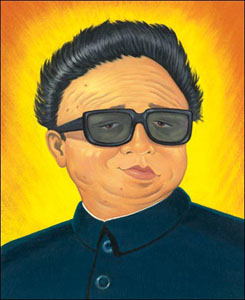
Kim Jong-il: Will he offer Washington
renewed nuclear talks before Nov. 4?
Novosti, Russia
Will Kim Jong-il
Offer McCain an Election Gift?
"The entire history of North
Korea's nuclear program is an example of how to operate directly on an
audience, for instance, the pre-election United States. … Now everything
depends on whether the North Korean authorities want to make a gift to American
Republicans on the eve of the voting."
By
Dmitry Kosirev
Translated
By Yekaterina Blinova
October 3, 2008
Russia - Novosti -
Original Article (Russia)
While America waited with
bated breath for the outcome of the voting in Congress on a $700 billion
bailout of failed financial institutions, and as U.S. voters watched the debate
of the two candidates for the vice presidency of the United States, in faraway
North Korea, another act in the nuclear-diplomatic drama quietly unfolded.
Assistant Secretary of State Christopher Hills crossed the border between South
and North Korea by car headed to the city of Pyongyang, where he spent an
unexpectedly long time - three days.
ABC NEWS,
AUSTRALIA AUDIO: North Korea test-fired two short-range missiles, Oct. 8,
00:03:14 
All that the outside world
has managed to glean from the trip is a photograph of Hill standing with
American and North Korean diplomats on the hill above the city - and very few details.
These were important talks intended to provide a path out of the unexpected
deadlock in the process by which North Korea was to abandon its nuclear plans
in exchange for the fulfillment of a number of demands.
It's unlikely that the talks
were entirely successful. Because on his way home during a brief conversation
with reporters in Seoul, Hill said he couldn't discuss the subject before
reporting back to Secretary of State Condoleezza Rice and representatives of
the other countries participating in Six-Party Talks on the “Korean nuclear
problem.” In addition to the United States and North Korea, those talks include
Russia, China, Japan and South Korea.
There's no doubt that if Hill
had been able to settle everything with Pyongyang, he would have forgotten all
about the six-sided format. And neither would Pyongyang mind doing so, with its
long-cherished dream of direct talks with the United States. But the two
couldn't agree on anything. They need all four of the other players as
guarantors and overseers of the conduct of the two sides, etcetera.
Playing lead fiddle, of
course, is China. U.S. State Department official Steve McCormack recently
recalled that during the course of Korean negotiations, it was necessary for
America to “deposit” various coordinated plans, declarations and the like in
Beijing. The burden was then divided among the other participants, and the
execution of the various arrangements was organized. This is a very interesting
point, reflecting the pecking order in east-Asian politics and the world at
large. But it hardly enables us to understand what Hill gleaned on his
unexpected trip.
The problem that arose
appeared to be purely technical. In 2007, the six-party talks had resolved the
nuclear Korean problem, having adopted a fairly detailed plan - a roadmap of
who does what, and how the other side should respond. What has happened since
has been a series of nervous reactions from one or the other side, over what
they perceive to have been ill-intentioned deviations from that roadmap.
This time,
Pyongyang accused Washington of not fulfilling its commitment to remove North
Korea from the list of terrorist-supporting states. There's a lot to be said
about the quality of this list: either you support terrorism or not; and if
this can be negotiated, what kind of list is that? But that is a separate issue
about the style of U.S. foreign policy.
The U.S. explains its
hesitance by pointing out North Korea's refusal to adhere to the agreed-upon
verification of its nuclear sites (which of course, it has rejected). This is
the very procedure which has inhibited a similar process with Iran, since it
involves unannounced random inspections anywhere in the country. As for the
North Koreans, who are accustomed to expecting a war and enemy spies, this is
of course unusual.
Regardless of how it
happened, it has been these “tiny” details of the supposedly finalized plan
that have triggered the current stalemate. And importantly, North Korea once
again commands respect. Last week, it expelled IAEA inspectors from its nuclear
reactor at Enben, where the seals placed there by inspectors were torn off, and
it promised to resume the enrichment of weapons-grade plutonium.
Experts threw up their arms in
amazement: after all, didn't they just blow up the reactor's cooling tower
[photos right] - how can any work be resumed there? But the entire history of
North Korea's nuclear program is an example of how to operate directly on an
audience, for instance, the pre-election United States. Never mind what the
experts say. More importantly, will it frighten the American voter.
Meanwhile, Pyongyang devised
yet another clever idea. South Korean satellites recorded some strange smoke
over a firing range near the village of Gilju in Hamgyong Province. It's the
same place where, on October 9, 2006 North Korea detonated something that
apparently allowed it to call itself a nuclear power. Never mind that the
experts have begun to throw up their arms again, questioning the quality of the
bomb they detonated. What matters is that Pyongyang has been able to push
six-party talks into moving at a more rapid pace.
Posted by WORLDMEETS.US
Some people who have seen the
satellite images say it could be a smokescreen to conceal from satellites
preparations for a new nuclear test. Of course, the same effect could be
obtained by a bucketful of burning rags that someone wanted to get rid of.
And while North Koreans
burned rags and laughed, Washington thought to itself: Is this good news on the
eve of the elections - the detonation of a North Korean nuclear bomb right
after Condoleezza Rice’s assurances that everything is fine?
We'll find out, of course,
what Hill has accomplished in Pyongyang, what plan he brought to his North
Korean colleagues, and whether they liked it. Most likely, the plan was a good
one. Now everything depends on whether the North Korean authorities want to
make a gift to American Republicans on the eve of the voting (in the form of a
resumption of the disarmament process), or choose to wait until the new
administration enters the White House. Then they can burn their rags on the
firing range once again.
CLICK HERE FOR RUSSIAN
VERSION
[Posted by WORLDMEETS.US October 9, 2:30am]







 [LATEST NEWSWIRE PHOTOS: North Korea destroys nuclear cooling tower].