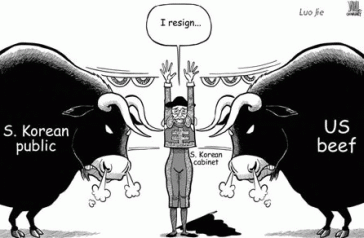
[China Daily, People's Republic of China]
JoongAng Ilbo, South Korea
Crisis 'No
Longer About Safety of U.S. Beef' …
“People no longer care whether U.S. beef
is scientifically safe … A lot of the anger is about the negative sentiment
that people have against the government and its way of coping with the United
States.”
-- Chung Seok-ju, a 45-year-old
Trading Company Employee
By Lee Min-a
June 20, 2008
South Korea
- JoongAng Ilbo - Original Article (English)
President Lee Myung-bak yesterday
expressed regret over his government's handling of the deal agreed to in April
over the resumption of American beef imports. The deal has prompted street
protests by tens of thousands of people over the past month.
“My government and I are carefully reflecting on this issue,” he said in a
nationally televised statement. “While this was a national matter that required
urgent attention, I should have paid more attention to whether people would
accept it and what they would want.”
He also said that if the people reject it, he will drop plans for the Pan-Korea
Grand Waterway  , one of his major campaign pledges.
Reactions were divided on his statement.
Some remain angry and say they no longer trust a government that made blunders
like misinterpreting the beef deal with the United States. [Government negotiators have had to admit
that when they signed on to the deal, they had misinterpreted some of the
English-language regulations in it, especially those pertaining to the age of
the beef being imported. The rumor has spread throughout South Korea that cows
that are older than 30-months are more susceptible to Mad Cow disease].
Some said that the president’s apology wasn't enough, but that they want to
halt the daily protests and see what the government will do next.
In response to Lee’s speech, which was broadcast live, 29-year-old student Cho
Hyeon-jong said, “The speech was full of hollow, flowery language. He never
mentioned what this country would do if a case of mad cow disease arose, nor
did he say how the government would ask the United States to take
responsibility.”
Chung Seok-ju, a 45-year-old trading company employee, said that the president
still doesn't understand the problem.
“People no longer care whether U.S. beef is scientifically safe,” Chung said.
“A lot of the anger is about the negative sentiment that people have against
the government and its way of coping with the United States.”
Lee Hye-ri, a 28-year-old office worker, said she felt that the speech was
somewhat touching.
“It was much better than last time, when President Lee made his first national
address seeking understanding from the people about why he was importing U.S.
beef,” she said. “You can tell that this time, he sincerely thought about his
people.”
Indeed, Lee expressed more emotion this time.
Looking into the camera, Lee said, “Sitting alone on a dark hillside and
looking at downtown Seoul as it swarmed with people holding candles, I
reproached myself for not having been able to serve the people better and ease
their concerns. Over and over until late at night, I have considered the
situation deeply. I have looked back at what I have done again and again.”
He continued, “I stand here today to explain frankly what has happened, to
apologize and to ask for your understanding. In retrospect, I have been
impatient since my election as President. In light of the experiences of
previous administrations, I believed that I wouldn't be able to succeed without
bringing about changes and reform within my first year in office.”
He also explained that if passed, the Korea-U.S. Free Trade Agreement would
produce about 340,000 good jobs and the increase the country’s GDP by over 6
percent over the next decade.
Posted by WORLDMEETS.US
“As President, I didn't want to let this golden opportunity slip away. I could
not sit idly by without making every effort. I couldn't stand by and watch this
door of opportunity being slam shut,” he said.
Won Hyo-suk, a 56-year-old housewife, was generous to Lee.
“I think we told the President enough about what we want,” she said. “We should
give him a chance now to work so that he can straighten things out.”
The Blue House said there long discussions have been held about how the
President would make this statement. Initially, the Blue House considered a
simple announcement. Just the day before, the Presidential Office suggested
that they invite Blue House reporters to the President’s office for a debate.
But instead, it decided to hold a “special press conference.” After the
President’s speech, he fielded questions from the floor.
Lee also denied the widespread speculation that the government was planning to
privatize state-run health care and utility firms.
There are rumors that the Blue House had been planning to announce the outcome
of the additional talks being held with the U.S. and that if the talks had gone
well, the President would have announced that the Korean government had
succeeded in revising the beef pact and securing extra safeguards against Mad
Cow disease. The fact that he apologized instead, critics say, shows that the
talks aren't going well. The Blue House firmly denies this.
mina@joongang.co.kr
[Posted by WORLDMEETS.US June 19, 7:05pm]







 [LATEST NEWSWIRE PHOTOS: South Koreans Hold Large Daily Protests Against U.S. Beef].