Russia's 'Silicon
Valley' Will Go the Way of China's Treasure Fleets
Has
Dmitry Medvedev learned all the wrong lessons from 20 years of Russian
capitalism? According to Gazeta columnist Yulia Latynina, the Russian
president's recent visit to California will be for naught if he follows through
with plans for a state-guided version Silicon Valley in Moscow's suburb of
Skolkovo.
A painting of Zheng He, China's most reknowned explorer, returning from a voyage in the 1400s: While many lament how the next emperor put an end to his voyages, columnist Yulia Latynina sees the decision as perfectly good sense.
Why
was it Europe that discovered America and not China?
This question has two answers.
One might be that in fact, America was discovered by China. Between 1421
and 1423, the fleets of the Emperor Zhu Di’s right-hand
man - a eunuch named Zheng He
(a Muslim, incidentally), rounded the Cape of Good Hope, forged far into the
Atlantic Ocean and passed through the Caribbean to Patagonia.
But when the fleet returned
home, it found the old emperor dead, the eunuch’s faction out of favor, and sea
voyages banned by the new authorities, who equated the export of goods from the
country with treason. Furthermore, they burned all blueprints of the ships, and
even confiscated records of the fleet’s travels from the state archives, as
they contained ideas considered harmful and unnecessary to the empire’s
subjects.
In China, the state was
unified. Emperor Zhu Di discovered America, and the Emperor Zhu Gaozhi declared
it off limits. But in Europe, there were many states. Columbus offered his
services to five European rulers and the Sultan of Turkey - all of whom refused
him; only the Spanish accepted.
[Editor's Note: While it's
clear that the new emperor of China ended the Treasure Fleets, the assertion
that Zheng He landed in the Americas, made by Gavin Menzies in his book 1421:
The Year China Discovered America, is widely-questioned].
The first lesson of this tale
is very simple: when the state is central to the act of discovery, the probability
of error is extremely high. More technologically advanced and developed than
Europe, China endured centuries of isolation due to one decision by single
emperor. Meanwhile in Europe, mutual competition between states led to an era
of geographic discovery.
[Editor's Note: For a hint of
the disdain China felt toward Europeans and the backward inhabitants of other
nations, read this 1793
letter from Emperor Qian Long to King George III of England. The letter was
to reject Britain's request to establish formal relations and trade. This was
the same British king that lost the Revolutionary War to American colonists who
formed the United States].
The second lesson, however,
is less obvious and far more terrifying: the fact was that Emperor Zhu Gaozhi
was in fact completely justified in prohibiting geographical discoveries.
In
order to understand why, one has to explain what Zhu Di's fleets really were.
Like any major official
venture, these were grand fleets that were completely ruinous to state coffers.
Every fleet contained dozens of ships - also known as "Treasure Fleets,"
the building of which demanded entire groves of teak. The rudder of one such
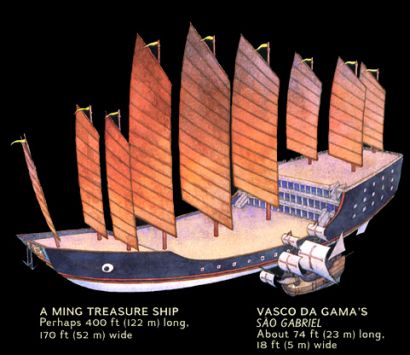
ship was almost the length of all of Columbus’ caravels [see picture below]. Constructed
with watertight bulkheads invented by the Chinese 1,000 years before Europeans,
the teak vessels were covered with three layers of planks, the gaps between
which were filled with a very expensive oil finish made of Tung Oil, lime and bird glue.
Aboard each ship were 180 (!) doctors, not to mention stone cutters, artisans
and even concubines brought along for the pleasure of senior officials.
A
comparison of a Ming Treasure ship with the vessel of Portugal
explorer
Vasco de Gama. The ships of Columbus - the Nina, the
Pinta and the Santa Maria - were similar in size. The Santa
Maria
was
the largest - at 87 feet.
The integrity of these ships
was fantastic: they could have struck an iceberg without capsizing; and on
board there was no scurvy, because the wise doctors fed sailors soy sprouts and
fresh fruit. Meanwhile, the generosity of these explorers was beyond
description.
Posted by WORLDMEETS.US
Aboard these ships were precious
goods like silk and porcelain, which were handed out in all newly-discovered
lands. Because after all, they represented a Great Empire! This was the right-hand
of the Chinese emperor, not some European pauper, eating worm-ridden bread, from
a ship that would likely capsize at the slightest storm and plunder the moment
they disembarked.
But of course, this was quite
correct from the standpoint of the Chinese state. Why build eggshells that will
capsize during a storm? Let us build a "Treasure Fleet" that can
withstand a typhoon. Why plunder newly-discovered lands? Why suffer from scurvy?
The problem was that all of
these state concerns led to the construction of fleets that were of such quality,
they were too expensive to sustain in that era. Paradoxically, the decision of
Emperor Zhu Di to build gigantic fleets and his son’s decision to burn their
blueprints were not different policies - they were versions of the same policy.
It was a policy in which government, not a small and private Columbus, decided
what everyone needed.
The story of the Chinese Treasure
Fleets has been repeated many times throughout history. for instance, when Khrushchev
ordered the planting of corn. Corn is a wonderful thing, and American
farmers were earning millions on it. But when the decision to plant corn was
made by government officials rather than farmers, things went badly.
Posted by WORLDMEETS.US
Now in Skolkovo,
the story of the Treasure Fleet is repeating itself again. The Kremlin has
launched its own Silicon Valley and put a Russian version of Zheng He at its
head - Viktor
Vekselberg. But excuse me, who is in charge of Silicon Valley?
Firstly, it's obvious that wrong
investment decisions is far more likely with a single decision maker than a
situation in which many people make decisions. Secondly- and this is less
obvious but far more important - every investment decision made by the state under
these circumstances will be wrong. Because any such investment would be guided
by the logic of Zhu Di rather than that of Columbus.
The logic of Columbus is very
simple: we have very little money, so let's sail in a shell of a vessel, eat
worm-ridden biscuits and drown along the way. State logic is different: let's
invest as much money as necessary, build a reliable vessel, bring along concubines,
carpenters and even flowers that we'll irrigate with fresh water.
I have no doubt that a
majority of projects in Skolkovo, for instance the cloud computing project,
will pay off. Why not? First, the government will finance everything as necessary,
including a triple-coating of lacquer and cabins for the concubines. Then
developers will project costs sufficient to cover a triple-coating
of lacquer. Then large corporations will be told: please buy our cloud
computing services; otherwise the project won't make a profit …
Just
how this is relevant to innovation remains unclear.