"What's at stake goes beyond torture. Under the auspices of
Bush and the invocation of the imperative of national security, his intimate
circle - Cheney, Rove, Rumsfeld and Gonzales - attempted to transform the U.S.
into a police state. This came close to disfiguring the country."
A dilemma reminiscent of countries that went from
dictatorship to democracy confronts history's greatest democratic nation. Indeed,
the United States is discussing whether, how and to what point it should
investigate the systematic torture of terrorism suspects by the CIA at
Guantánamo and their secret detention centers abroad - with written authorization
from the Bush government. A bitter debate ensued last week when, facing a
lawsuit by the American Civil Liberties Union based on the Freedom of
Information Act, the White House divulged four memos
prepared between 2002 and 2005 by the Justice Department's Office of Legal Counsel
- which is the Executive branch's last word on the interpretation of laws.
The memoranda - addressed to the CIA - regulate the use of 14
brutal interrogation techniques which are described in detail. The documents were to ensure
that the violence would be consistent with American and international law. (For example, to
avoid being accused of violating the Geneva Conventions, among other treaties
signed by the United States, the Bush Administration decided that terrorists
were "illegal combatants.") The most cited form of torture,
waterboarding, was used in the 1940s by Japanese soldiers considered criminals
after the war, and by the Khmer Rouge in Cambodia during the 1970s. One CIA
prisoner suffered this type of torture 183 times in a single month. Other
methods included sleep deprivation for 11 days straight and showers at 5 degrees
celsius [41 degrees fahrenheit].
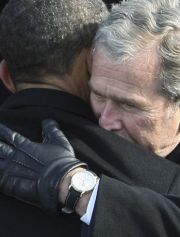
As soon as he took office, President Barack Obama reversed
these opinions legitimizing torture - and ordered the closure of all secret
prisons and Guantánamo within a year. But as he publicly released conclusive
proof that under Bush, the fundamental values of the United States had been denied,
he promised that no CIA agent would be charged if he or she acted in accordance
with these legal opinions, so as, "not to spend so much time and energy in
laying blame for the past that it interferes with our ability to focus on the
fundamental mission." Obama instructed Democratic leaders in Congress to
oppose plans by Democrat Patrick Leahy to create an independent commission
to investigate the conduct of the Bush government in regard to torture. The
Speaker of the House, Nancy Pelosi, who is also a Democrat, supports the idea.
For their part, human rights organizations are demanding the
appointment of a special prosecutor to investigate the extent of what Obama
himself called "a dark chapter" in American history. For now, only
the Justice Department's Office of Professional Responsibility is pursuing a preliminary
investigation into the conduct of those who prepared the memos. The Senate
Intelligence Committee will soon begin a preliminary investigation, the results
of which should emerge by the end of the year. After praising the president for
disclosing the memos, an editorial on The
Torturers’ Manifesto, written Friday in The New York Times, points
out that if the Executive doesn't conduct an exhaustive investigation of the matter,
Congress by default has the constitutional duty to do so.
Strictly
speaking, what's at stake goes beyond torture - which, moreover, has proven
ineffective according to experts on counter-terrorism, and has undermined
cooperation between the United States and some European allies like Germany in battling
their common enemy. Under the auspices of Bush and the
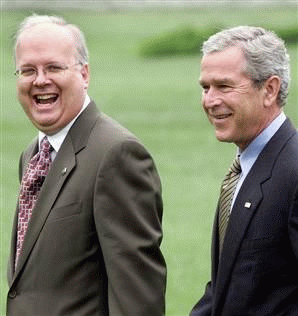
invocation of the imperative of national security, his intimate circle - Vice
President Dick Cheney, Deputy Chief of Staff Karl Rove, Secretary of Defense
Donald Rumsfeld and Attorney General Alberto Gonzales - attempted to transform
the U.S. into a police state. Their dictatorial tendencies were exacerbated but
not created by September 11th. With Congress and the press disheartened, they
[the administration] put in place a system that provided the president with
extraordinary powers, and, if not secret, exercised serrupticious control over society.
Bush authorized tapping into the communications of anyone the government wanted
- and on a scale that surpassed even the ample limits of legislative authority
it had obtained. This came close to disfiguring the country.