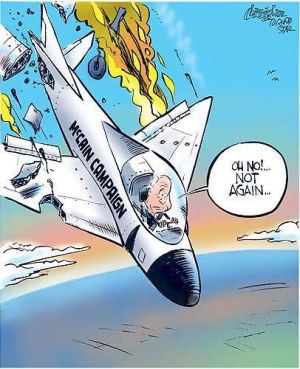
The Obama-McCain
Debate: A 'Warning' to Mexicans …
"Beyond the volatility of the
stock market, currency exchange rates and organized crime, we have a wide front
of issues to attend to in relations with our neighbor to the north … Twelve
million Mexicans live north of the Rio Grande, half of them undocumented. ..
and here live one million Americans, one fifth of all those that live outside
of their homeland. … it's a country which, whether we like it or not, has a
huge impact on our own."
Thursday's final debate
between the candidates for the presidency of the United States, Barack Obama
and John McCain, is a warning to us that beyond the volatility of the stock
market, currency exchange rates and organized crime, we have a wide front of
issues to attend to in relations with our neighbor to the north.
Not only because
of our 1,950-mile border, shared oil deposits, the common threats to our
security, migration and international trade worth $300 billion, but because of
the slow and relentless demographic integration of the two countries.
Twelve million
Mexicans live north of the Rio Grande, half of them undocumented, and an
estimated 20 percent of Mexican families have at least one relative in the
American Union.
Here, on the
other hand, live one million Americans, one fifth of all those that live
outside of their homeland.
We are accustomed
to hamburgers, hot dogs and pizza, and they enjoy tacos, burritos, nachos and
jalapeños. We applaud Madonna and they sing along with mariachi players and
listen to Los Corridos [Music of the Mestizos - people of mixed
European and Indian stock - see video below], in particular, even on tours
organized by the Smithsonian Institute.
Spanish is the
second language of the United States with 45 million Spanish-speakers, while
here, English is the educational accessory of the upper class.
Republican
McCain, a hero of war, was here during his campaign; and Obama has visited us
from the other side of the border, the way Vice Presidential candidate Sarah
Palin, the governor of Alaska, has seen Canada, and across the Bering Strait,
the outline of the Russian coast.
Despite what the
polls say, either of them can win. And it's not up to us to take sides, but
rather outline the key points for resolving the problems that stand in the way
of the appropriate development of a bilateral relationship that has many
advantages to offer.
The United States
is still the world's dominant military and economic power. The collapse of Wall
Street shook the global financial system. And since we're neighbors, there are
inevitably other unexpected consequences to our relations: it's known, for
example, that a border sheriff had family connections with one of Mexico's most
feared drug-kingpins.
Mexicans
risk life and limb sneak across the border: Will a
better
solution ever be found?
There are also
families made up of half brothers - some Mexican, others United Statesian - formed by the dynamic hustle and bustle
that can't be stopped by walls or border patrols.
In Los Angeles' Olvera Plaza, the cry of “Independence!” is celebrated in Zapotec [one of Mexico's indigenous languages spoken in and around Oaxaca, Mexico] and the number of Poblanos
in New York is such that a mountain village receives visitors with two clocks:
one with the local time and the other with New York time [Poblanos
are from Mexico's mountainous Puebla State].
Twenty percent of
Mexican families are supported with the help of remittances from their
relatives employed in the country to the north, and soldiers of Mexican origin
have heroically died in the Iraq War.
But between the
two countries lies a third nation, comprised of several million people
coexisting and linked together by cross-border trade, each with his own
identity and loyalty to their homeland.
Posted by WORLDMEETS.US
It doesn't matter
who is considered the winner of last night's debate. Both would serve the
supreme interests of the United States. From the Mexican side, however, it
would be a good idea to reconsider bilateral relations - but not blindly. We
need a fuller understanding of what the United States is and how it functions,
whether that be for convenience or self-defense.
It's therefore
important that we abandon the willful ignorance that has historically cost us
so much, and that our government agencies closely follow the political and
economic activity of a country which, whether we like it or not, has such an
impact on our own.