Iran-Backed Extremists
Must Not Be Allowed to Thwart Talks
"Rather
than being an act of resistance, Hamas' killing of four Israelis on the first
day of negotiations was obviously done at Iran's behest. Hamas was simply giving
voice to their Tehran masters on the streets of the West Bank."
Amidst clashes between extremist
Palestinians and Israelis hell bent on fomenting trouble in the region, direct peace
talks have begun in Washington between Palestine and Israel. The extremists are
creating this turmoil because they have no control over decision-making and lack
solutions to issues at hand.
Rather than being an act of resistance,
Hamas' killing of four Israelis on the first day of negotiations was obviously done
at Iran's behest. Hamas was simply giving voice to their Tehran masters on the streets
of the West Bank. Similarly, on the other side, a statement by Rabbi
Ovadia Yosef in which he wished for God to eliminate the Palestinians was
issued to derail the talks. Extremists on both sides have been trying to thwart
peace efforts, which are essential to Palestine, the Arabs and the entire world.
For several decades, Arab
nations, including Palestine, have remained weak, finding it impossible to stabilize.
Arabs and Palestinians have been wasting their energy on factional infighting, including
the most recent, which was the division between Hamas and the Palestinian
Authority. In order to hold Gaza for its Iranian masters, Hamas has delayed holding
a dialogue with the government, thus providing Israel with another chance to
perpetrate atrocities against Palestinians and Arabs.
Hamas and other Middle
East mouthpieces of Iran seem unable to grasp that their endless dark tunnel only
leads to a loss of national rights. On several occasions, Palestinians haven't
been able to unify and stand up to the Iranian head wind.
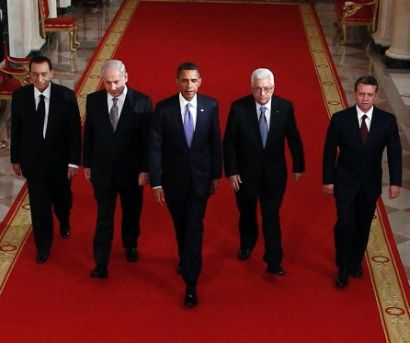
From left to right: Egypt President Mubarak, Israel
Prime Minister
Netanyahu, President Obama, Palestinian
Authority President Mahmud
Abbas and King Abdullah II of Jordan, walk to
the White House East
The best recent example of
this was a statement by Iran's Majlis [Parliament] Speaker Ali Larijani, which
was a clear interference in the internal affairs of Palestine and Lebanon
through Hezbullah and Hamas. These groups have set several Arab states on fire,
while Iran violates international rules, implements its expansionist program and
remains far from the fray.
[Editor's Note: Larjani is
quoted as predicting the failure of peace talks and regretted that "some Palestinian groups" (Fatah) have welcomed
the talks. He said that Israel's security was Washington's "only obsession."]
The noise created by
extremists can't be permitted to override moderates, so the negotiations must
remain on course. This is a necessity, of only to send Israel a message from
the entire world that it must be realistic in handling Arab issues. And the
United Nations must understand that the Arab Peace Initiative
isn't just a trial balloon, but a real strategic option for Arabs to deal with Israel's
misdeeds.
Israel has always impeded
efforts to resolve the issue of Palestine and halt violence in the region. It's
on this point that the interests of Iran and Israel seem to intertwine. Israel
continues to build settlements on occupied Palestinian territory, while Iran
provokes tension in the Arabian Gulf, inhibits the formation of a new Lebanese cabinet
and prevents the people of Gaza from choosing the most likely method of ending
sanctions.
The extremists will continue
to attempt to thwart peace talks. This is a historic challenge confronted by
all of the region's powers. They will either fall victim to their violence or, for
the for the sake of the Palestinians, continue to push for real peace.