Iran
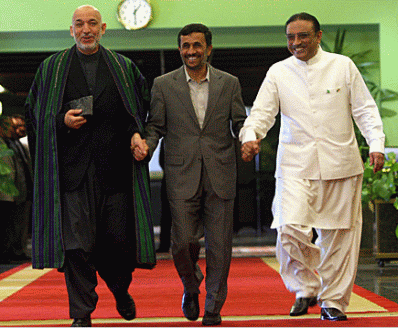
President Ahmadinejad, center, hosted a summit on Sunday
with
President Karzai of Afghanistan, left, and President Zardari of
Pakistan.
But according to the editorial board of Pakistan's Frontier
Post, their agreement to jointly battle extremists has little chance
of
succeeding unless Iran-U.S. ties improve.
The Frontier Post,
Pakistan
Afghan-Pakistan-Iran
Deal Depends on the United States
"They
should be natural allies, but whether one likes it or not and for whatever
reasons one wishes to name, the fact is that the foreign policy options of
Afghanistan (drastically) and Pakistan (to a lesser extent) are limited by the
will of the United States."
EDITORIAL
May 26, 2009
Pakistan - The Frontier Post - Home Page (English)
The commitment to jointly battle
their common enemies of extremism, militancy and terrorism by the presidents of
Iran, Afghanistan and Pakistan at their Tehran summit was laudable. The real
problem, however, is the history of relations over the least three decades among
the three brotherly states.
Apart from their geographical
proximity, they have much in common that should serve as a basis for everlastingly
binding their peoples together. They should be natural allies.
Posted by WORLDMEETS.US
Yet it has not been these commonalities
that have shaped their relations. Instead, compulsions fraught with
unquenchable animosity have often times been the drivers of their ties. Had they
allowed there mutual affinities to guide their affairs, in all probability the
three countries would not now be so blighted by the monstrosities of extremism,
militancy and terrorism that exact such a heavy toll. There's no point going
into that dismal past. What is done is done - and cannot be undone.
But if history can't be
re-written, the narrative of what happens now and in the future is open. To do
better this time will necessarily entail unvarnished sincerity, commitment and
a steely resolve, come what may. But that's easier said than done. If the past
is any guide, one must be indeed skeptical. Without apportioning blame, none of
these three fraternal states has an unblemished track record. None have acted
correctly and angelically; each has sinned against the others - even if in
varying degree.
When Afghanistan allowed
itself to be ravaged by civil strife and internecine conflict, incited, fueled
and backed by foreigners, both Pakistan and Iran were caught fishing for
trouble in Afghanistan's waters by backing opposing rivals. An example is the
late 1990s, when Islamabad sat in the ruling Taliban’s corner while Tehran sided
with their adversary, the Northern Alliance [as did the United States].
Posted by WORLDMEETS.US
If all of this is
over and real changes of heart have occurred in Kabul, Tehran and Islamabad, this
should augur well for upcoming relations between the three. But there's a snag.
For the Tehran Declaration to come to fruition, it is imperative that the three
have complete sovereign control of their foreign policies. This cannot be said
of Kabul or Islamabad, although Tehran may have decisive foreign policy control.
Whether one likes it or not and for whatever reasons one wishes to name, the
fact is that the foreign policy options of Afghanistan (drastically) and Pakistan
(to a lesser extent) are limited by the will of the United States.
That leaves open the question
of whether this new commitment among Afghanistan, Pakistan and Iran will succeed,
as U.S. relations with Tehran remain frosty, notwithstanding the new U.S.
administration’s warm overtures. Then there's a domestic factor that could
potentially stall the execution of this commitment. Both Iran and Afghanistan will
soon hold presidential elections and in both the countries, the incumbents are running
again. So at least for now, carrying out this commitment is bound to take a
backseat to hectic electioneering. And there's yet another predictable hitch: due
to the lack of a serious challenger, Afghan President Karzai seems like a
shoo-in. And since he is abhorred by the Obama Administration, there's feverish
talk of elevating someone of Washington’s choice as the country’s true national
leader [a prime minister], with Karzai reduced to being an ineffectual head of
state [such as the office of Israeli president, presently occupied by Shimon
Peres]. Given the overarching influence of the United States due to the huge
amount of aid to the country, even regarding Afghanistan's domestic affairs, this
may indeed come to pass.
SEE ALSO ON THIS:
The Frontier Post, Pakistan:
Karzai's 'Odes to Pakistan' Come Too Late to Stop India
The Frontier Post, Pakistan:
Pakistanis 'Don't Give a Damn' What Americans Think
The Frontier Post, Pakistan:
'Pakistan in a Trance, Doing America's Dance'
The Nation, Pakistan:
'No Nuclear Surrender'
The Nation, Pakistan:
To Reduce Militancy, the U.S. Must Pressure India
As Safir, Lebanon:
Obama and bin Laden Confront 'Day of Reckoning'
Asia Times, Hong Kong:
Al-Qaeda Seizes on Taliban's Problem
Asia Times, Hong Kong:
Thanks to U.S.,
Taliban Have a New Target
Asia Times, Hong Kong:
Karzai Gets the 'Last
Laugh' on White House
The Telegraph, India:
Obama 'Deliberately Dramatizes' al-Qaeda Threat for Domestic Political Reasons
In such an eventuality, little
definite can be said about Kabul’s commitment to combating militancy and
extremism in concert with Tehran and Islamabad. That would depend largely on
American relations with Iran.
Nevertheless, the signing of a
bilateral agreement between Iran and Pakistan for the long-pending plan to
build a gas pipeline is a happy outcome. One hopes that work on this project
will now begin without waiting for India, which has for so long delayed the
project.
[Posted by WORLDMEETS.US May 27, 12:17am]